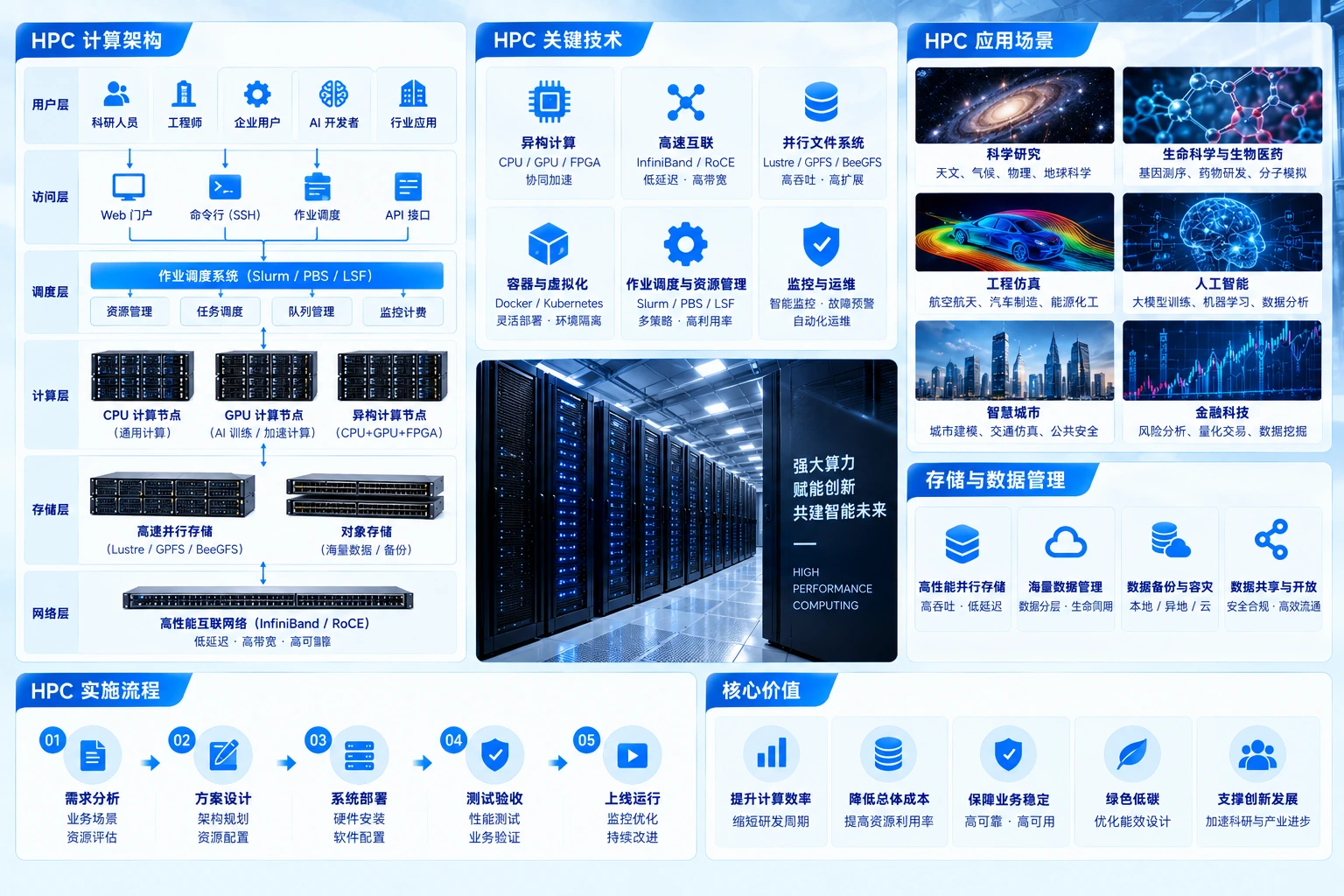
Platform view

Compute platform structure

  • 01 Compute goal
  • 02 Nodes
  • 03 Interconnect
  • 04 Scheduling
  • 05 Storage

02 / System integration and infrastructure

High-Performance Computing (HPC)

Build an HPC environment around CPU/GPU nodes, high-speed interconnects, shared storage and job scheduling that workloads can use continuously.

High-performance computing HPC cluster nodes
HPC is not about adding more servers; it is about making nodes, networks, data and scheduling improve parallel efficiency together.
System objectsCPU/GPU nodes, high-speed interconnects, shared storage and job scheduling
Technical focusCompute nodes / InfiniBand / queue scheduling
Operational focusqueue time, network bottlenecks, resource contention and reruns

01 / Problem profile

HPC is not about adding more servers, but making parallel resources actually work

High-Performance Computing (HPC) projects are often split into equipment purchasing, network configuration and application delivery, while dependencies, capacity boundaries and operating ownership are not confirmed together.

For CPU/GPU nodes, high-speed interconnects, shared storage and job scheduling, the baseline, business goals and technical boundaries need to sit in one decision chain, showing which resources must coordinate, which traffic must be isolated and which incidents need automatic failover or human intervention.

This matters because when dealing with job scale, node utilization, parallel efficiency and energy use, the team can explain performance, availability, incident impact and expansion instead of only checking whether equipment is online.

Three core integration gaps

Reduce recurring delivery, connectivity and handover problems to three core gaps before sequencing the technical work.

01

Systems work separately but do not coordinate

Equipment or software can work alone, but interfaces, state and ownership across CPU/GPU nodes, high-speed interconnects, shared storage and job scheduling remain unclear.

Solves: define objects, boundaries and interfaces before commissioning.
02

Performance and capacity have no shared baseline

Individual equipment or metrics cannot show the true carrying capacity as job scale, node utilization, parallel efficiency and energy use grows.

Solves: assess capacity, performance, redundancy and growth together.
03

Incidents lack a clear action path

Without health checks, alert levels, failover conditions or rollback, incident response returns to guesswork and amplifies queue time, network bottlenecks, resource contention and reruns.

Solves: include validation, failover, recovery and ownership in delivery.
04

The environment cannot be maintained after delivery

Configuration, interfaces, monitoring, contacts and maintenance windows are not turned into updateable records, so expansion and change require rediscovery.

Solves: hand over a searchable, reviewable and maintainable technical baseline.

02 / Architecture

Connect the parallel-computing chain from nodes to job queues

Architecture is not a model list for CPU/GPU nodes, high-speed interconnects, shared storage and job scheduling; it connects carrying conditions, relationships, control policy and operating ownership in one technical chain.

Confirm the relationships across Compute nodes, High-speed interconnect, Storage and data, Scheduling and operations before deciding equipment, software, networking and delivery sequence, so problems are controlled before go-live.

Each layer needs inputs, outputs, verification and an owner, forming a traceable path from site to business result and supporting job scale, node utilization, parallel efficiency and energy use.

HPC nodes, high-speed networking and shared storage architecture
Organize CPU/GPU nodes, high-speed interconnects, shared storage and job scheduling into a technical chain that can be explained, verified and maintained.

Four relationship layers

Trace the chain from site connectivity to business operations

A system needs to be read in its relationships to understand which links, access rules, applications and operating actions a device change will affect. These four layers form one path from facility conditions to business outcomes.

01

Compute nodes

Compute nodes needs clear boundaries, connection methods, validation criteria and operating ownership.

02

High-speed interconnect

High-speed interconnect needs clear boundaries, connection methods, validation criteria and operating ownership.

03

Storage and data

Storage and data needs clear boundaries, connection methods, validation criteria and operating ownership.

04

Scheduling and operations

Scheduling and operations needs clear boundaries, connection methods, validation criteria and operating ownership.

03 / Technical scope

Break the HPC cluster into five verifiable technical surfaces

For CPU/GPU nodes, high-speed interconnects, shared storage and job scheduling, scope needs to be confirmed across site, platform, connectivity, operations and handover instead of being completed from a purchasing list alone.

The five surfaces cover Compute nodes, InfiniBand and high-speed networking, Parallel file and shared storage, Job scheduling and resource queues, Monitoring, optimization and handover; a missing surface pushes risk into commissioning or operations.

Breaking down the scope tells the project team what to install, verify and record, and who will maintain it afterwards.

HPC job scheduling and resource queue view
Turn CPU/GPU nodes, high-speed interconnects, shared storage and job scheduling from a concept into tasks that can be checked on site.
01

Compute nodes

Compute nodes needs boundaries, configuration, performance and acceptance confirmed together.

Scope / configuration / verification / ownership
02

InfiniBand and high-speed networking

InfiniBand and high-speed networking needs boundaries, configuration, performance and acceptance confirmed together.

Scope / configuration / verification / ownership
03

Parallel file and shared storage

Parallel file and shared storage needs boundaries, configuration, performance and acceptance confirmed together.

Scope / configuration / verification / ownership
04

Job scheduling and resource queues

Job scheduling and resource queues needs boundaries, configuration, performance and acceptance confirmed together.

Scope / configuration / verification / ownership
05

Monitoring, optimization and handover

Monitoring, optimization and handover needs boundaries, configuration, performance and acceptance confirmed together.

Scope / configuration / verification / ownership

04 / Connectivity and resources

High-speed interconnects determine HPC efficiency and failure radius

Connectivity for CPU/GPU nodes, high-speed interconnects, shared storage and job scheduling must consider throughput, latency, isolation, redundancy and failover, not only whether equipment is online.

Describe Low-latency interconnect, Topology and bandwidth, Job traffic isolation, Failure and task retry across business, management, data and failure paths to understand which services a change can affect.

Use connectivity, performance, health and failover tests to turn Compute nodes / InfiniBand / queue scheduling into a baseline for troubleshooting and expansion.

01

Low-latency interconnect

Low-latency interconnect needs clear boundaries, metrics and incident actions.

02

Topology and bandwidth

Topology and bandwidth needs clear boundaries, metrics and incident actions.

03

Job traffic isolation

Job traffic isolation needs clear boundaries, metrics and incident actions.

04

Failure and task retry

Failure and task retry needs clear boundaries, metrics and incident actions.

HPC cluster GPU and InfiniBand network topology
Connectivity should show where traffic comes from, where it goes and how to handle queue time, network bottlenecks, resource contention and reruns during an incident.

05 / Capacity and operations

Compute resources must keep answering whether nodes are being used effectively

Resources are not static values; review them continuously against job scale, node utilization, parallel efficiency and energy use.

Operations must watch Node utilization, Job queues, Data throughput, Energy and maintenance together to know whether the configuration remains within acceptable performance, availability and maintenance boundaries.

Monitoring, alerts, trends, change records and reviews keep updating the technical baseline so expansion, optimization and incidents do not depend on temporary experience.

HPC cluster utilization and task monitoring
Turn Node utilization, Job queues, Data throughput, Energy and maintenance into operating signals that teams can act on quickly.
01

Node utilization

Node utilization becomes part of daily checks, monitoring, alerts and capacity decisions.

02

Job queues

Job queues becomes part of daily checks, monitoring, alerts and capacity decisions.

03

Data throughput

Data throughput becomes part of daily checks, monitoring, alerts and capacity decisions.

04

Energy and maintenance

Energy and maintenance becomes part of daily checks, monitoring, alerts and capacity decisions.

06 / Delivery and handover

Deliver HPC as an operable platform from benchmarks to workload acceptance

High-Performance Computing (HPC) projects cross site, equipment, networks, platforms and business teams, so delivery must connect survey, configuration, commissioning, validation and handover.

  1. 01

    Baseline and site inventory

    Review CPU/GPU nodes, high-speed interconnects, shared storage and job scheduling, existing records, interfaces and site constraints.

  2. 02

    Architecture and configuration

    Define Compute nodes / InfiniBand / queue scheduling, resource boundaries, redundancy and delivery windows.

  3. 03

    Install and commission

    Install and configure equipment, platform, networks, policy and interfaces, then commission in phases.

  4. 04

    Scenario and failure testing

    Verify performance, health, failover, recovery and queue time, network bottlenecks, resource contention and reruns.

  5. 05

    Records and operations handover

    Hand over topology, configuration, assets, monitoring, contacts, maintenance windows and next steps.

HPC servers and compute nodes on site
Configuration, state, test results and ownership are confirmed together at High-Performance Computing (HPC) acceptance.

07 / Handover records

High-Performance Computing (HPC) handover includes a technical baseline that can keep being used

Future procurement, expansion, troubleshooting and change depend on the same facts. Records must remain searchable, reviewable and maintainable.

01
Architecture and connectivity

Record CPU/GPU nodes, high-speed interconnects, shared storage and job scheduling, ports, links, addresses and system boundaries.

02
Configuration and policy

Keep equipment, platform, policy, version and access baselines.

03
Testing and recovery

Save performance, health, failover, recovery and queue time, network bottlenecks, resource contention and reruns validation results.

04
Ownership and maintenance

Describe contacts, checks, maintenance windows, alert response and expansion paths.

FAQ

Frequently asked questions

Confirm the service boundary and current conditions before deciding delivery scope and ongoing support.

What should be confirmed first when implementing High-Performance Computing (HPC)?

Start with the baseline, business goals, technical boundaries, capacity, dependencies and ownership before deciding equipment, platform and sequence.

Can High-Performance Computing (HPC) be built in phases?

Yes. Define interfaces, capacity, versions, validation and rollback so the first phase does not block expansion.

How do we keep records from becoming obsolete after delivery?

Treat topology, configuration, assets, monitoring, tests and contacts as an operating baseline, update them with changes and assign an owner.