
Turn company knowledge
into answers you can explore
Two interfaces, one retrieval pipeline. Yuqi Intelligent customizes knowledge preparation, workflows and integrations on Dify. Generation, embedding and optional reranking models are selected separately. Scope and results require project evaluation.
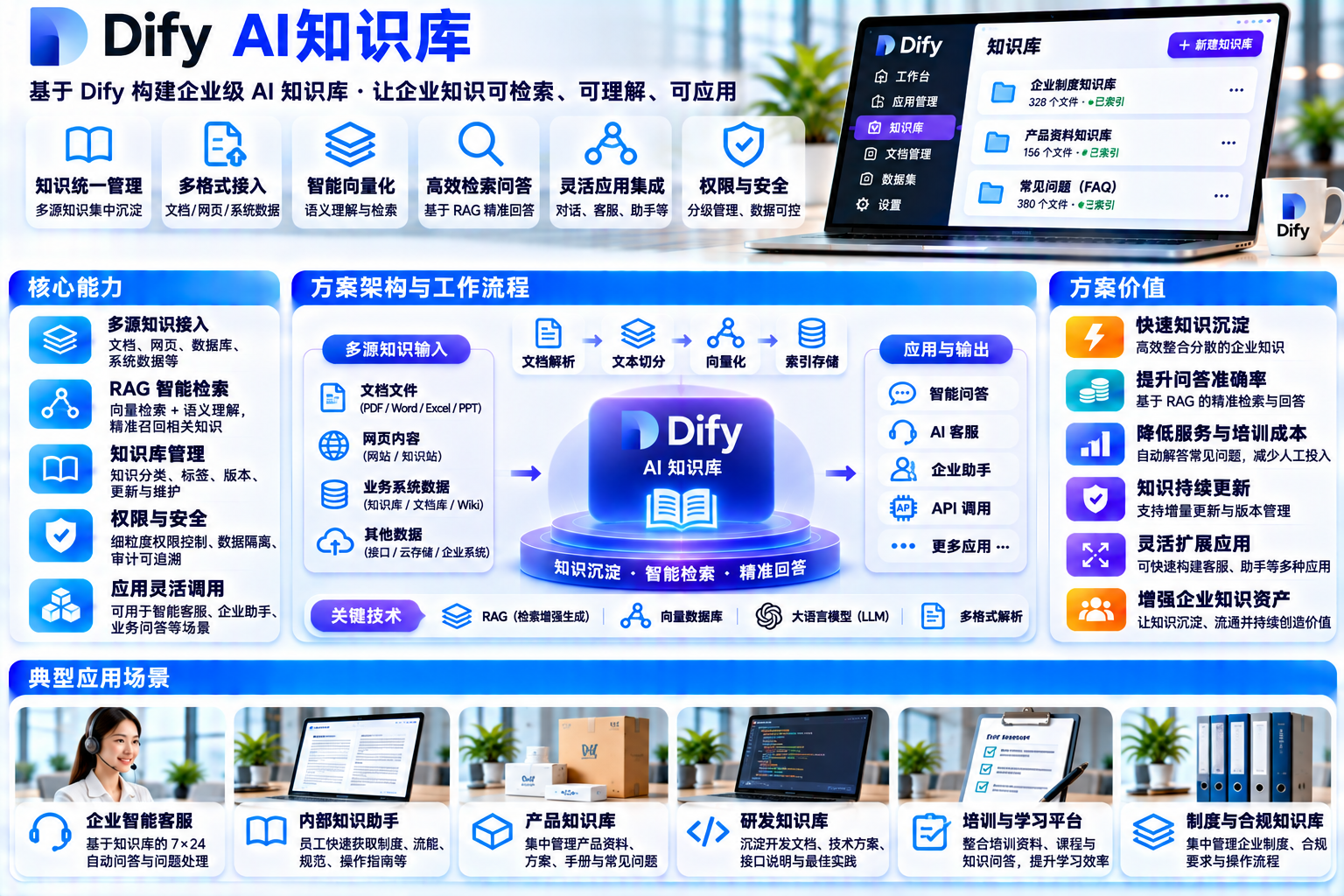
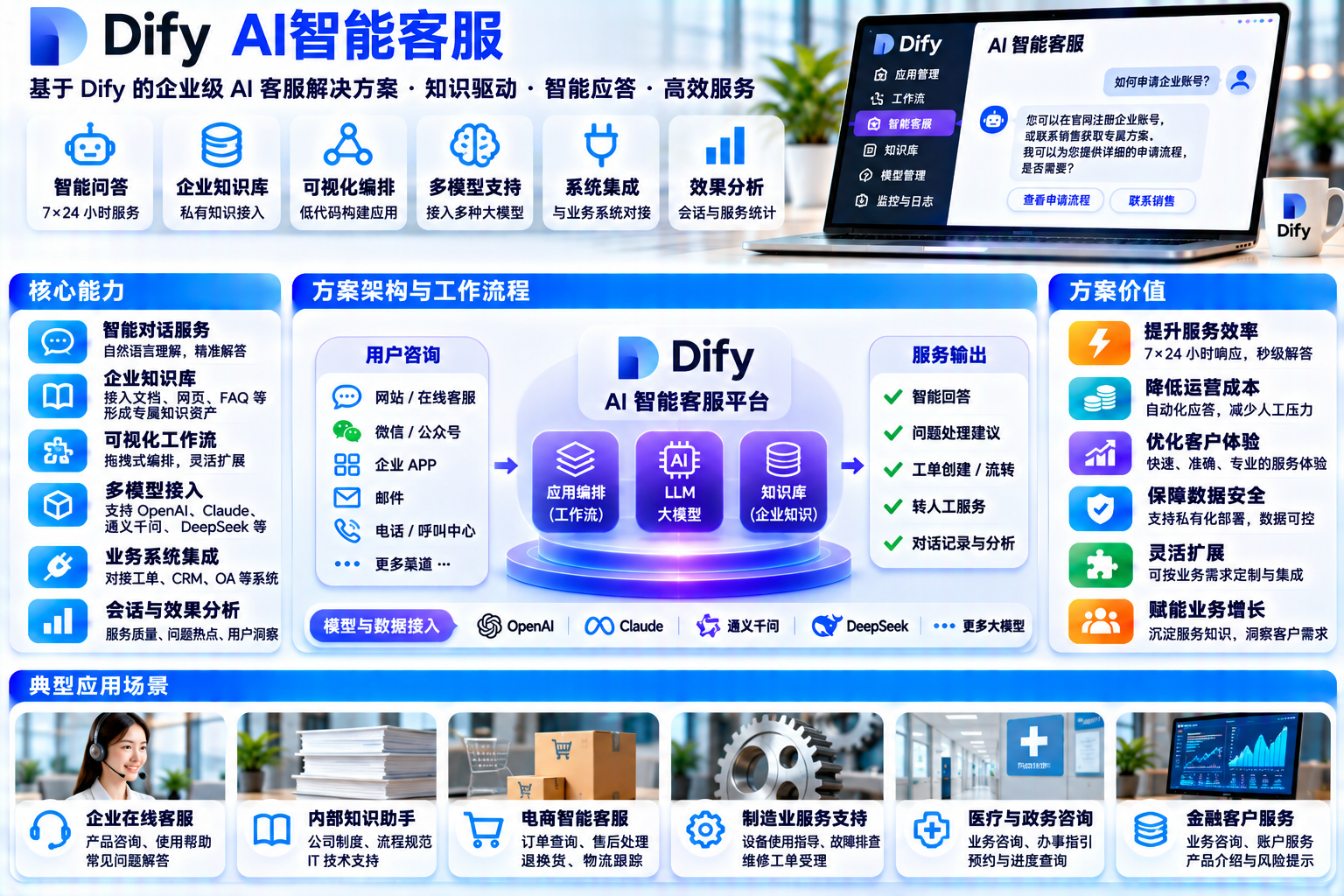
Interfaces, figures and prices are examples. Actual features, licensing and delivery scope are confirmed for each project.
First, identify who provides what
Dify is an LLM application development platform with workflows, RAG pipelines, Agents, model integrations, observability and APIs. It is not a language model or a bundle of model weights. Configure the generation, embedding and optional reranking models required by the chosen features.
Platform capabilities
Knowledge ingestion, chunking, indexing, retrieval settings, retrieval testing, Workflow / Chatflow orchestration, model integrations, logs and Service API.
- Knowledge bases
- Retrieval nodes
- Workflows
- API
Editions and quotas
Cloud plans have different document, storage, member, log retention and rate limits. Community deployment uses a single workspace. Review SSO, granular governance, multiple workspaces and applicable licensing for the selected edition.
- Document quotas
- Storage quotas
- Single workspace
- SSO / RBAC
External integrations
Website and portal interfaces, service channels, ticketing, business identity, SSO, object storage and observability services require integration. Dify is not a complete ticketing system; agree on the integration scope.
- Service channels
- Tickets
- Identity
- Observability
Yuqi custom engineering
Branded interfaces, knowledge organization and version rules, access mapping, no-answer and handover policies, citation display, evaluation sets, regression checks, deployment scripts and operations documentation.
- Custom interfaces
- Preparation rules
- Evaluation sets
- Operations guides
The LICENSE permits commercial use, including backend services and enterprise application platforms, subject to its additional conditions. Review the complete selected-version license and any required commercial authorization.
Operating a multi-tenant environment with Dify source requires explicit written authorization. A single customer's workspace deployment and a multi-tenant SaaS service have different licensing implications.
When using Dify's frontend, including its web directory or Docker web image, preserve the console and application logo and copyright information. The branding restriction does not apply to uses without its frontend. The license also includes a design-patent statement.
Review the selected-version LICENSE and deployment model before commercial delivery, especially tenancy and frontend branding. Enterprise features, support and commercial authorization depend on the written agreement with Dify.
The same information, two ways to use it
The knowledge interface prepares maintainable, searchable content. The service interface uses retrieved evidence to answer employees and customers. They share a processing pipeline but have different entry points, access rules and failure handling.
Enterprise knowledge base
Organize policies, product information and project documents into searchable, maintainable assets. Source quality and chunking determine what evidence an answer can use.
AI customer service
Answer product, service and common questions using company documents and reference excerpts. Configure explicit no-answer handling and human confirmation when evidence is insufficient.
Human handover, service channels and ticketing are external integrations . The required depth, from a link or API callback to a complete agent workspace, must be agreed for the project. They are not automatically included.
Try the workflow, inspect the evidence
Switch documents to inspect chunks and simulated retrieval results, or choose a preset question to view an answer and its references. Interfaces, content, scores and states are simulated; this is not a launched system.
Business interface concepts / Interactive demo
Not the official Dify interface Not a launched system DEMO ONLYSelect a question to view simulated chunks and example scores.
Two pipelines, retrieval-augmented answers
Retrieval-Augmented Generation retrieves relevant company excerpts and passes them to the model as context without changing its weights. Play, pause or step through the pipelines. Reduced-motion settings disable animated transitions.
Import documents
Import local files, websites or online documents…
Parsing and cleaning
Extract text from supported document formats…
Split into chunks
Set chunk boundaries, size and overlap…
Embedding
Use an embedding model for vector indexing…
Index and maintain
Maintain indexes, metadata and document versions…
Import documents
Import local files, websites or online documents. Data-source options, limits and whether a source can be changed depend on the knowledge-base type, version and deployment plan.
User question
Users ask through a portal or integrated channel…
Retrieve knowledge
Retrieve candidates and apply configured thresholds…
Optional reranking
Select and configure an optional reranking model…
Assemble context
Pass relevant excerpts to the model as context…
Model generation
Generate an answer from the question and context…
Answer and sources
Return the answer, references or a no-answer result…
User question
Employees or customers ask through a portal, service window or integrated channel. Channel and identity connections are part of the integration scope.
RAG / add context at retrieval time
Keep model weights unchanged. Retrieve relevant excerpts for each question and send them with the prompt. Update source content through parsing and indexing rather than training.
- Suitable for changing policies, prices and product information
- Source excerpts support human review
- Quality depends on content, chunking, indexes and retrieval settings
Training / fine-tuning changes weights
Training adapts model parameters through prepared examples and requires evaluation. It is not a simple way to precisely update or remove an individual fact.
- Useful for stable styles, formats and task behavior
- Not the sole maintenance method for frequently changing documents
- This proposed service focuses on RAG; model training is outside its scope
Route missing or insufficient retrieval to an explicit no-answer branch. Explain that no supporting material was found, and offer document updates or human confirmation according to policy.
Track document versions and effective dates. Refresh indexes as required, flag historical matches and verify the current rule before use.
Constrain generation to the provided context and acknowledge uncertainty. Keep source excerpts and human confirmation available; escalate when necessary.
A source indicates where an excerpt came from. A model may still misread it, combine passages incorrectly or infer beyond the context. Evaluate answers with a test question set covering common, boundary, unanswered and outdated-information cases. Record retrieved evidence and human review, then rerun checks after content or parameter changes. No accuracy, savings or customer results are claimed.
From interface to model, define each responsibility
Layers separate the application, knowledge processing, storage, model services and external systems. Cyan identifies platform components; amber identifies selected integrations. Access control, identity, audit and handover require project design.
Dify provides workspaces and member management; enterprise SSO and governance capabilities depend on the edition. Yuqi configures role mapping and least privilege, using the organization's account and structure information.
Metadata filters narrow retrieval but do not constitute complete authorization. Cross-department access requires server-side authorization, trusted identity-derived filters and verified knowledge isolation.
Mapping the existing account system into an application is an external integration ; define which identity attributes are passed and how they enforce document access.
Dify provides application logs and retrieval records; retention, fields and export capabilities depend on the selected edition. Integrating the organization's audit platform requires a separate scope.
A no-answer branch can suggest human support; agent workspaces, conversation transfer and ticket creation require actual integrations and are not included by default.
Five recurring needs, one knowledge foundation
Scenarios differ in document scope, questions and access rules. Reuse the foundation where appropriate. All example questions are fictional.
Employee policy questions
Turn scattered handbook and process rules into an interface that supports follow-up questions and source inspection.
What are the travel accommodation limits?Presales product questions
Use current product and service documents to answer scope, configuration and quotation questions without mixing versions.
Which services are included?After-sales support
Help frontline teams find SOPs and previous resolutions, with explicit human handling when evidence is insufficient.
How is out-of-warranty service charged?Project knowledge reuse
Retain environment differences, incident handling and configuration templates as searchable project knowledge.
What should we check before implementation?Employee onboarding
Maintain training resources and common questions centrally so new staff can ask directly instead of searching entire document sets.
How do I request system access?Scenarios are illustrative, not customer case studies. No implementation outcomes, accuracy, response times or staffing savings are invented.
What the customer receives
Agree on deployment and licensing before defining deliverables. These describe proposed services, not completed projects or measured outcomes.
01Dify Cloud(SaaS)
Dify Cloud plans define document, storage, membership and log-retention quotas. Suitable for a scoped evaluation after reviewing data processing by Dify Cloud and the selected model providers.
02Customer-hosted Community Edition
The official Compose starting minimum is 2 CPU cores and 4 GiB RAM, excluding separately selected model compute. Bundled services include PostgreSQL and Weaviate. Configure HTTPS, replace development credentials and verify capacity before production. Review single-workspace constraints.
03Enterprise / custom frontend + API
Review Enterprise licensing for multiple workspaces, SSO, support and service commitments. A separately built frontend can call Dify's Service API; tenancy and applicable licensing still require review.
DELIVERABLES / Five reviewable outputs
Configuration
Model integrations, indexing and retrieval settings, knowledge access, environment variables, credential inventory and network policies.
Custom code
Business interfaces, identity and access adapters, citations, no-answer policies, handover and agreed webhook or ticketing integrations.
Knowledge preparation rules
Document naming and version policies, parsing, cleaning, chunking, metadata, expiry markers and index update procedures.
Evaluation evidence
Test questions, retrieval records, human review, regression conditions and known limitations. No accuracy guarantee is implied.
Operations documentation
Deployment and upgrade guides, backup and recovery procedures, credential rotation, logs, alerts, monitoring and incident handling.
Proposed extensions / Separate evaluation
These are potential extensions. Availability, licensing, model selection and acceptance criteria require separate agreement.
Agree on the boundaries, then plan implementation
Start with document scope, model selection, deployment and evaluation criteria to define the knowledge and service application.
Five questions to confirm
Confirm these items in writing during discovery. They determine feasibility, licensing, data flows and acceptance criteria.
Use the established business contactDiscuss knowledge bases and AI customer service
Review documents, access, service interfaces and data flows to agree on customization and delivery.
Contact Yuqi 139 1891 4454supports@yuqi-sh.comAll solutions- Deployment: Dify Cloud, self-hosted Community, Enterprise, or a custom frontend with API integration.
- Models: generation, embedding and reranking providers; permitted external APIs and data processing boundaries.
- Licensing: tenancy, use of Dify's frontend and branding requirements.
- Documents: formats, volume, versions, expiry, access responsibilities and ownership of updates.
- Acceptance: test questions, retrieval records, human review and regression conditions.
Photo sources and usage record · Dify LICENSE