
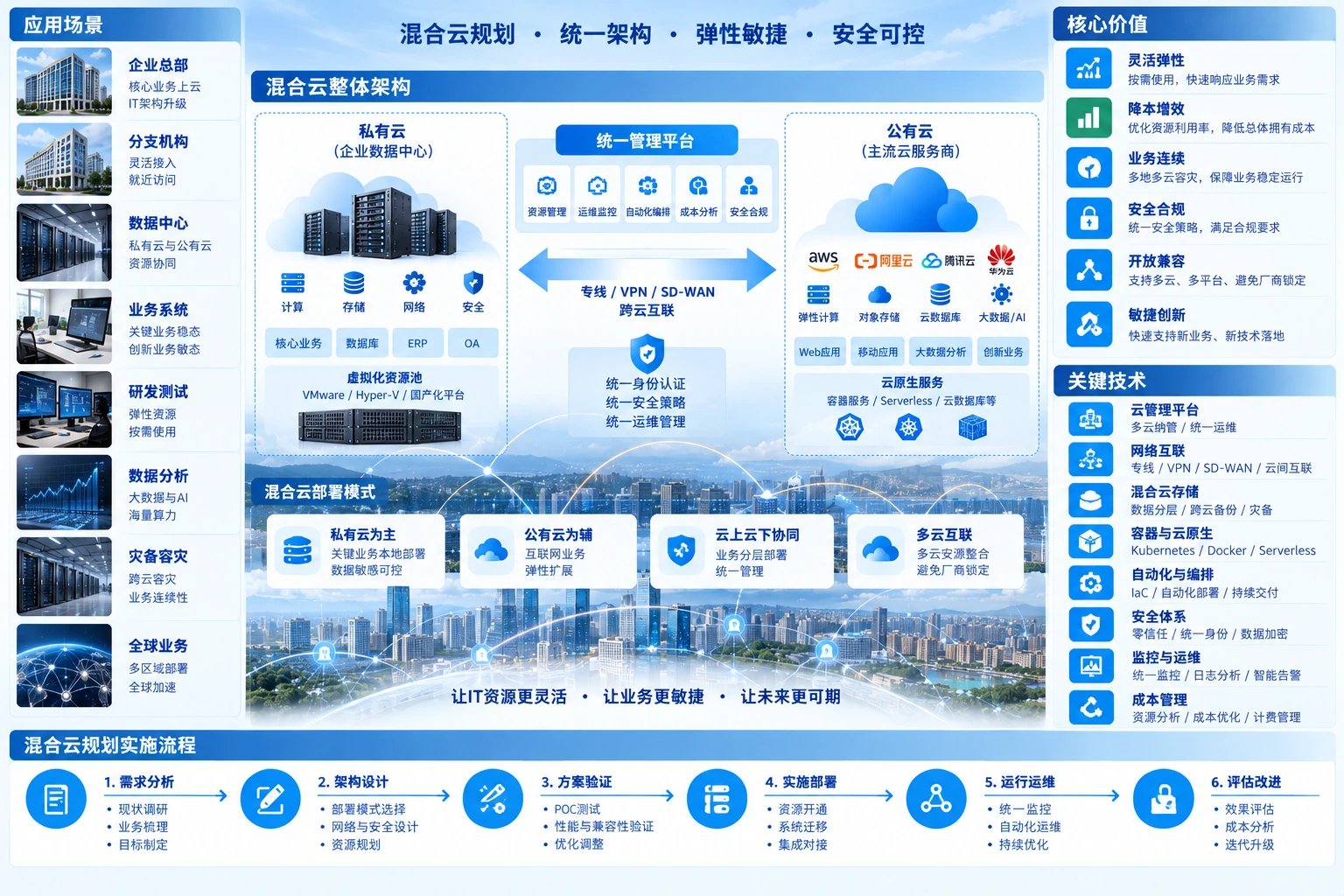
On-premises / Private environment
Workloads and data retained after assessment
Compute / Storage / Security zones
Site access and local operations

Virtualization and cloud platforms / Hybrid cloud
Keep workloads that belong on premises running reliably, while using suitable cloud capabilities on demand. Yuqi Intelligent plans business placement, cross-cloud networking, identity and data protection, then delivers assessment, integration, migration and handover.
Hybrid cloud is not just having resources on both sides; it is making them cooperate under defined rules.
Why it matters
Hybrid cloud connects on-premises infrastructure or private clouds with public-cloud services to support business together. Applications, data and management may reside in different places, coordinated through explicit networking, identity, interfaces and operating rules.
Consider hybrid deployment when core systems must remain local but new business, development/testing or demand needs flexible resources. It is not mandatory for every enterprise. Heavy cross-environment dependencies, expensive links or limited operations capacity may favor a simpler design.
How the architecture works
Separate business access from management coordination. Local and cloud systems communicate through business dependencies, while management tools collect status, configuration and alerts over supported interfaces. Unified management does not route every application flow or make resources freely interchangeable.
Management interfaces coordinate policies and status; they do not replace the business connectivity below.
Workloads and data retained after assessment
Compute / Storage / Security zones
Site access and local operations
Dedicated circuits / VPN / Optional SD-WAN
Routing / DNS / Access policies
Application interfaces and data transfer
Selected applications and managed services
Cloud networking / Compute / Storage
Cloud permissions and resource quotas
Define primary and secondary copies, permitted synchronization, recovery objectives and takeover steps before validating backup or replication. Connectivity alone does not establish consistency, automatic recovery or unlimited elasticity.
This is a relationship diagram, not a fixed product solution. Dedicated circuits do not inherently provide end-to-end encryption; encryption, routing, bandwidth and failover need separate design. Test replication and takeover rather than assuming hybrid cloud automatically provides disaster recovery. Animation is not live telemetry or a performance measurement.
Where workloads belong
Hybrid-cloud value comes from well-defined cooperation. Application, data and user relationships affect placement before platform ownership does.
Assess local operation for systems tightly coupled to production equipment, internal data or low-latency interaction. Keeping data local does not require every frontend to remain local.
Assess cloud resources for periodic testing, external-facing applications and scalable services. Effective expansion also depends on architecture, data reachability and licensing.
| Relationship | Planning question |
|---|---|
| Application calls | Can call frequency and latency tolerate different locations? Which functions fail if the link is interrupted? |
| Data movement | How are transfer volume, synchronization direction, retention location and egress costs calculated? |
| Identity and access | Can user authentication, service accounts, DNS and access policies work consistently on both sides? |
| Backup and recovery | Does the destination have recovery resources and business dependencies, not just a copy? |
Frequently asked questions
Hybrid cloud emphasizes cooperation between local/private environments and public cloud. Multi-cloud means multiple cloud environments or providers. They can overlap, but multiple accounts alone do not form a coordinated architecture.
No. Plan account permissions, segmentation, access rules, transport encryption and logs. Circuit isolation does not supply every encryption or business-authorization layer.
Applications, data, networking and capacity must support it, with consistency and recovery validation. Databases, dependencies and licenses impose different constraints; automatic failover and zero downtime cannot be promised universally.
No. Include equipment, licensing, circuits, cloud resources, egress, backups, operations and migration. Yuqi Intelligent assesses workloads and periods without assuming a savings percentage.
Starting with existing systems, equipment and team capabilities, Yuqi Intelligent plans local/cloud resources, integrates network security, deploys and migrates workloads, and hands over operations. Define provider, carrier and software responsibilities instead of stopping at a cloud shopping list.
Review application dependencies, data locations, users, peak loads and maintenance. Decide what stays local, moves to cloud or waits. Deliver topology, specifications, phased plans and cost components.
Select and supply servers, storage, networking and security equipment; configure local virtualization and cloud network/compute/storage. Separate permissions by account, project and security zone, checking versions and licenses.
Coordinate circuits or VPNs, routing, DNS, access policies and required encryption. Test link failures, application calls and data access, then migrate or deploy in agreed batches with cutover and rollback plans.
Define monitoring, logs, backups and alert responsibilities; validate agreed recovery or failover procedures. Deliver inventories, topology and runbooks, train administrators and support troubleshooting and capacity/cost optimization as agreed.
Next step / Current-state assessment
Share systems, data scale, access requirements, platforms and planned changes so Yuqi Intelligent can assess placement, connectivity and pilot scope.