

Database high availability
Database High Availability
Design a switchable, verifiable and maintainable database availability path around nodes, replication, failure boundaries, business connections, backup, recovery and operations monitoring.
01 / Nodes and boundaries
Connections and database roles
Database high availability is not simply adding another server. Define application entry points, how data synchronizes, which components share a failure domain and what the business sees during node, network or storage faults.
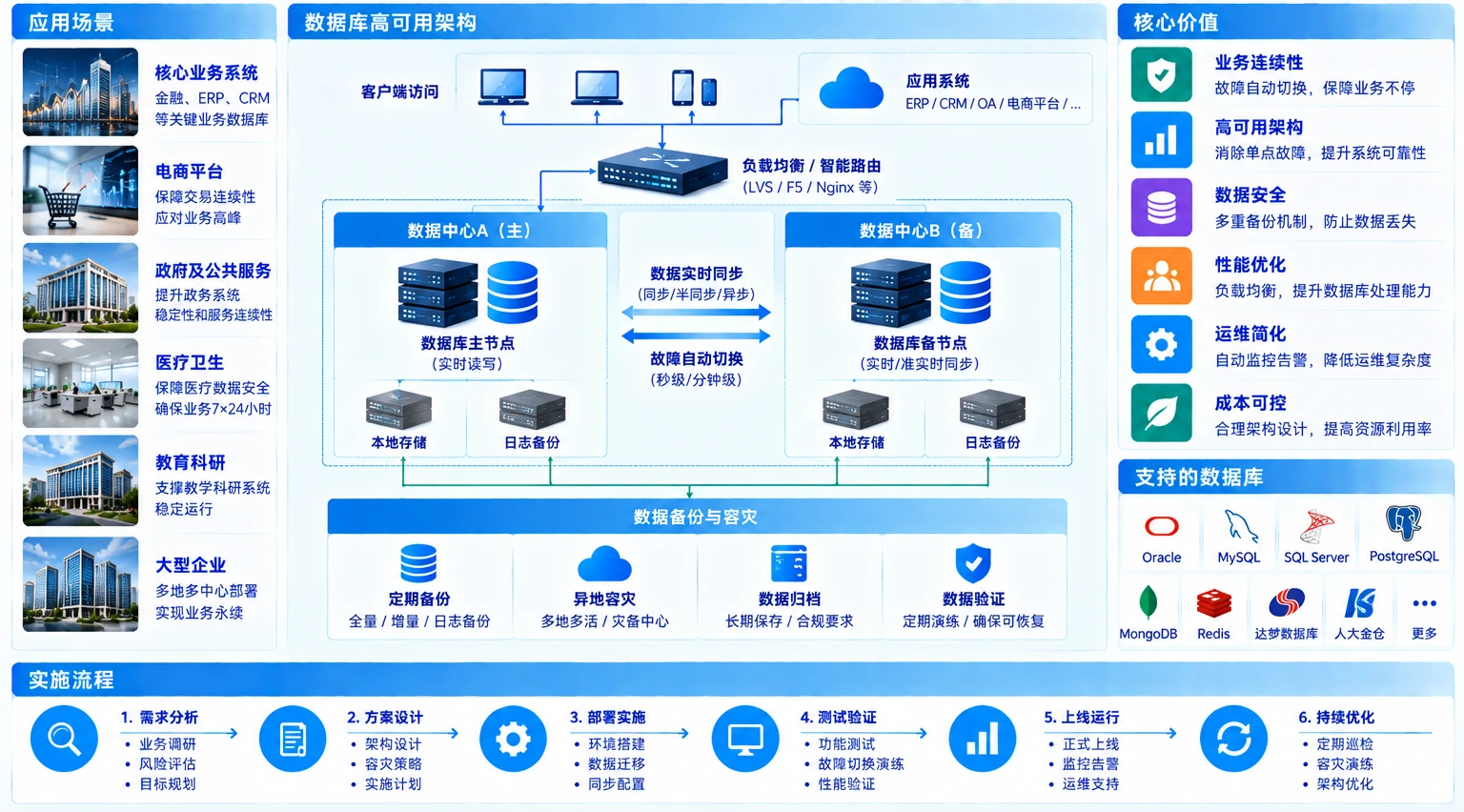
The architecture should answer who connects, who carries the workload, who synchronizes and who takes over instead of listing database software and hardware.
02 / Replication and protection
Availability and backup
Availability keeps service access continuous; it is not the same as historical data protection. Real-time replication, independent backup, offline or remote copies, recovery targets and checks belong in one protection boundary.
When deletion, logical corruption or a bad change occurs, switching to another node may carry the problem with it; an independent recovery path must be prepared.
What the pair can and cannot do
03 / Failover
Verify business after failover
Failover validation starts with connections, transactions, replication, application reconnects and data consistency. It is not enough for a node to show “online”; business requests must reach the new active node as intended.
Define the trigger signals and how to avoid false decisions and split brain.
Verify connection entry points, pools, transactions, caches and interfaces continue working.
Have the business check critical queries, writes, reports and upstream/downstream interfaces.
During a maintenance window, simulate node, link or storage faults and record detection, switch time, business impact, alerts and rollback conditions.
04 / Operations and handover
Operations and handover
After go-live, monitor replication lag, node health, log growth, backup completion, capacity headroom and alert handling. Handover records should tell operators what to watch, when to act and who escalates.
Put routine checks, exercises, configuration backup, version changes and recovery retests into one maintenance plan so availability does not degrade over time.
- State and capacityTrack nodes, replication, logs, storage and growth trends.
- Alerts and ownershipAssign owners and response times for lag, failures, low space and connection anomalies.
- Records and retestsKeep topology, configuration, failover records, exercise results and the next retest plan.
Next step
Review the failure boundary with a technical consultant
Bring the current topology, connection path, replication notes, backup policy and maintenance window.
Discuss database resilience