Working structure

Service operations structure

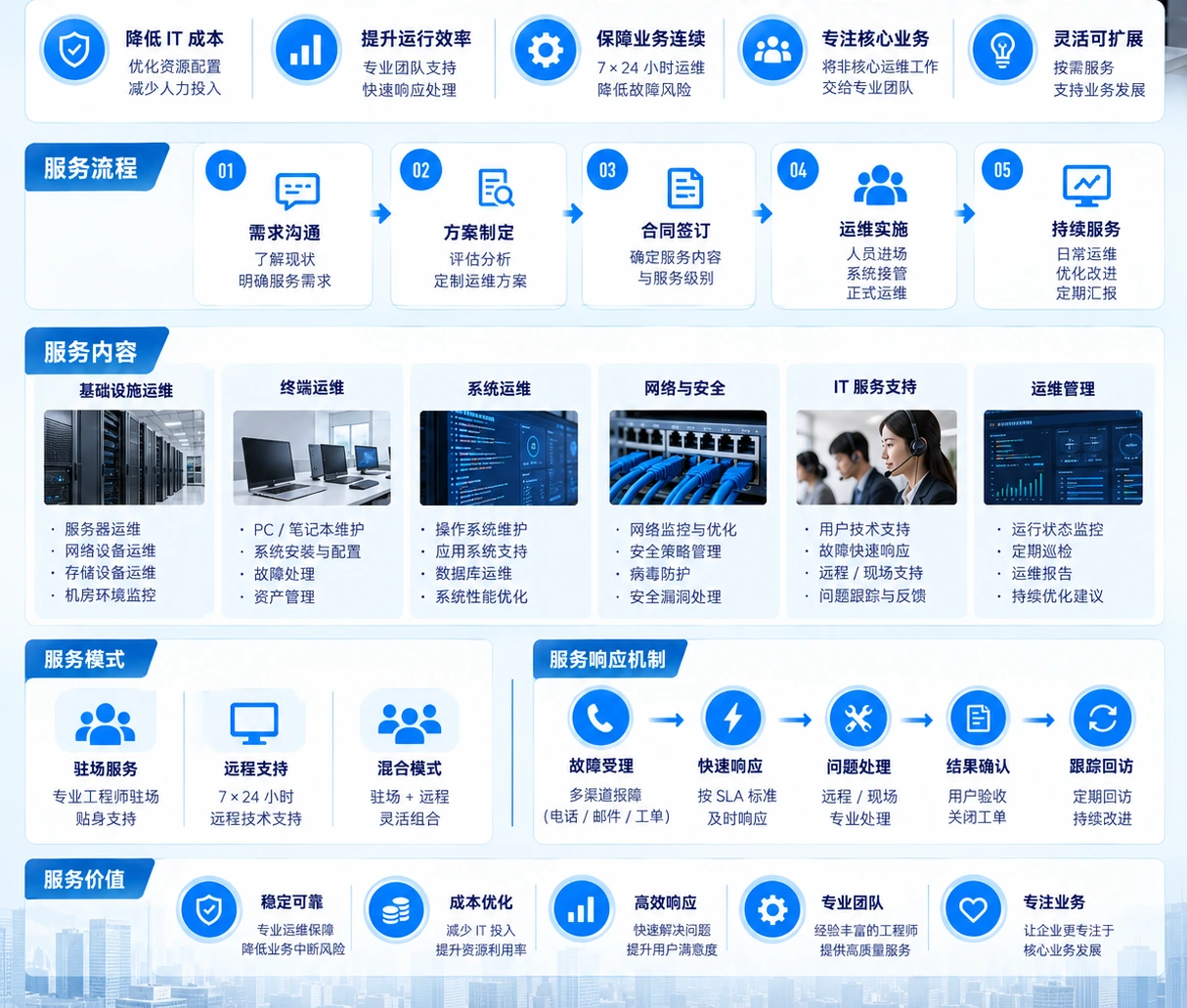
  1. 01 Asset baseline
  2. 02 Ownership
  3. 03 Operations flow
  4. 04 Handover and maintenance

Enterprise IT services / Managed operations

IT Managed Services

Bring fragmented server, network, endpoint and vendor work into one executable service boundary, reducing experience-only incident handling, undocumented changes and repeated ownership debates.

Enterprise IT managed-services architecture across objects, incidents and ownership
Place equipment, systems, incidents and ownership in one operating model.
Operating scopeServers / networks / endpoints
Service modelMonitoring / incidents / changes
Ongoing resultRecords / response / handover

Solve operating disorder first

Managed services are not only about having someone answer the phone

Enterprise incidents cross endpoints, networks, servers, applications and vendors. Without shared asset, incident, change and escalation paths, issues move between teams while the business waits for experience-based troubleshooting.

Enterprise data-center daily operations and equipment-status management
Monitoring, checks and equipment health are shared inputs to daily support.
01

Ownership is unclear

On-site, remote, vendor and business teams lack a clear first responder and acceptance owner.

02

Incidents lack records

Incidents, changes, rollback and review lack a shared format, so similar issues recur.

03

Operations stay reactive

Monitoring, checks, capacity and spares are not part of a regular rhythm, so teams respond only after impact grows.

01 / Service boundary

Define managed objects and ownership before response and support

Managed operations start with the actual environment: identify servers, networks, endpoints, backup, accounts, vendors and business systems, then mark what is managed, coordinated or out of scope.

Enterprise IT operations monitoring and incident coordination
Make the state traceable from discovery through verification.
01

Object baseline

Build the baseline list of equipment, systems, contacts, versions, addresses and dependencies.

02

Service layers

Separate monitoring, checks, incidents, changes, projects and vendor coordination.

03

Escalation path

Define response, escalation and business-acceptance paths by impact, urgency and technical boundary.

02 / Service execution

Build a traceable path from onboarding to steady operation

Start with baseline and priorities, then establish monitoring, incident, change and reporting rhythms so every item has an input, action, result and owner.

Technician performing maintenance in an enterprise server rack
On-site maintenance needs to align with configuration, windows, ownership and rollback.
01

Onboard and inventory

Review the environment, assets, accounts, vendors, backup and known issues.

02

Monitor and inspect

Watch availability, capacity, performance, backup and critical equipment health.

03

Incidents and changes

Handle incidents by priority, execute changes in windows and prepare rollback when needed.

04

Report and review

Use service records, trends and issue reviews to drive the next improvement cycle.

03 / Operating coordination

Make daily support, project changes and vendor work visible to one another

Sustainable operations connect daily tickets with longer-term improvement: recurring incidents enter the improvement plan, lifecycle affects budgets and major changes align business windows with vendor ownership.

Data-center infrastructure supporting enterprise IT managed services
Steady operations include equipment state, capacity and maintenance conditions.
01

Incident closure

Keep the full state and conclusion from discovery through assignment, handling, verification and review.

02

Change coordination

Align impact, window, contacts, validation conditions and rollback.

03

Capacity and lifecycle

Review capacity trends, warranty, spares and replacement plans monthly or quarterly.

04 / Service result

Managed services deliver an operating mechanism the organization can keep using

The value appears in clear boundaries, traceable response, verifiable change, transferable knowledge and an environment that can improve from its records.

01Managed objects, ownership and escalation path
02Monitoring, checks, incident and change records
03Vendor, spares and maintenance-window coordination
04Monthly / quarterly service report and improvement plan

FAQ

Frequently asked questions

Where do IT managed services usually start?

Start with an inventory of servers, networks, endpoints, backup, vendors and current incidents, then confirm scope and ownership.

Does the organization still need its own IT team?

Usually. Managed services coordinate and carry part of the work; they do not replace the organization’s ownership of business priorities, risk and key decisions.

How can managed-service quality be evaluated?

Review scope, response and recovery records, recurring-incident trends, change success, asset accuracy, reporting and business feedback rather than ticket volume alone.

Next step

Start with the current environment and a specific requirement

Share the current equipment, systems, site conditions, timing or issue so the practical scope can be reviewed.

Contact a technical consultant