
Enterprise infrastructure / Data-center colocation
Data Center Server Colocation
Putting servers in a suitable facility is only the beginning. Yuqi Intelligent reviews rack space, power and cooling, network access, installation and operational ownership to create a path that can be assessed, tested, monitored and handed over.
.jpg)
24/7 monitoring and response depend on the contract, equipment condition and on-site support boundaries.
01Why consider server colocation
Replace facility-build demands with verified operating conditions
Colocation is more than renting rack space. Confirm how power, cooling, networking, site access, remote maintenance and incident escalation support existing business systems.
Clarify conditions and responsibility boundaries before arranging equipment and links, so expansion, operations and handover do not require a fresh investigation.
Avoid building a facility from scratch
Colocation places rack space, power distribution, cooling, fire-safety and site maintenance under professional facility management, allowing the business to focus on its systems.
Equipment needs reliable access and service paths
Dedicated circuits, internet access, carrier cross-connects, remote management, installation windows and incident escalation need clear connectivity and ownership.
Expansion and operations need a reusable baseline
As server counts, power, space, ports and monitoring requirements change, retain inventory, configuration, alert, work-order and handover records.
02Enterprise links, racks and operational ownership
Connect the customer, network, facility and operations
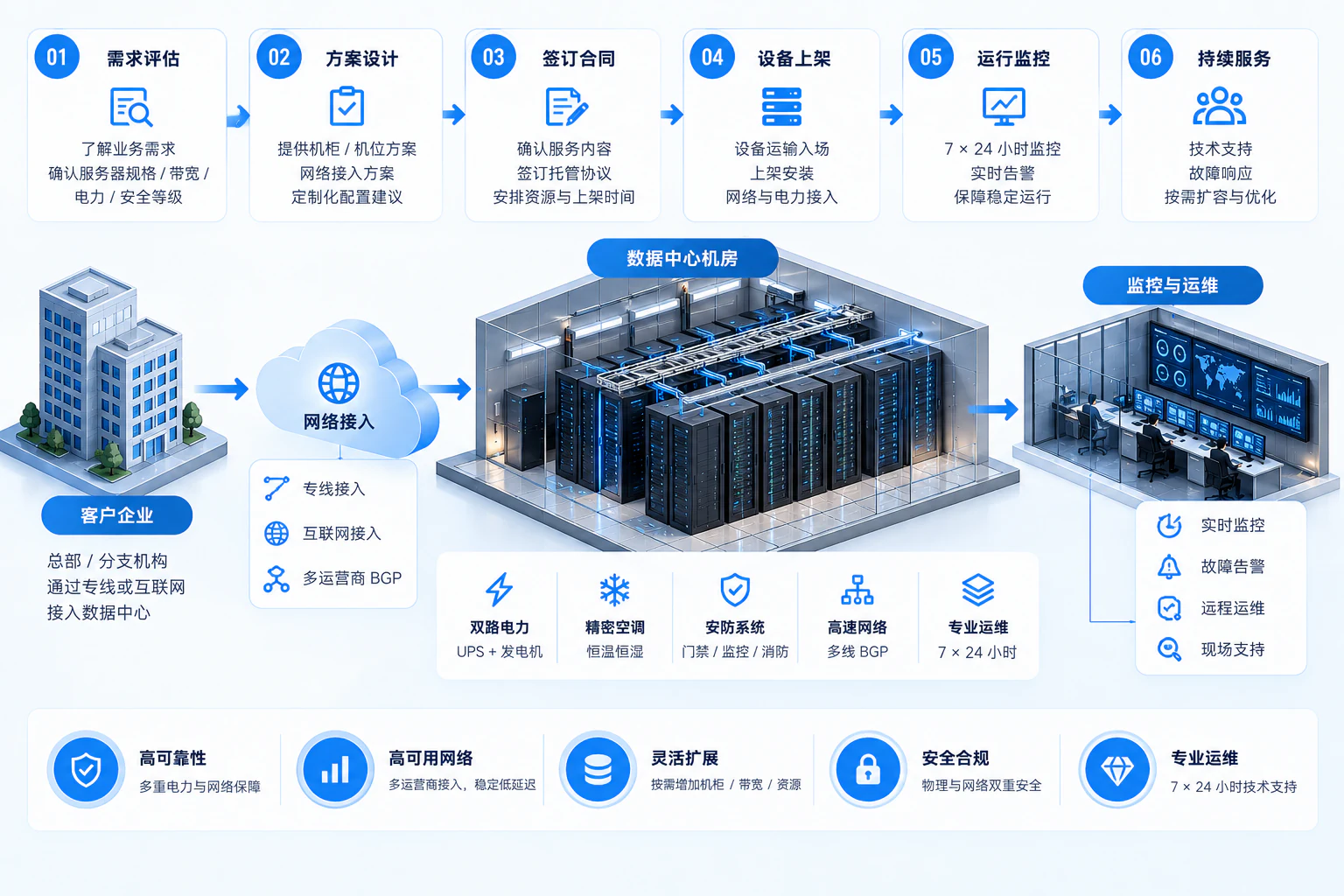
Customer equipment enters the data center under agreed space, power, cooling, network and security conditions, then receives monitoring, alerts and operational support. Animation illustrates relationships, not a specific topology, capacity or service-level promise.
Customer connectivity reaches the data center, where racks, dual power, precision cooling, security and networking jointly support servers, with monitoring and operations providing ongoing support.
Business systems and equipment inventory
03How Yuqi Intelligent helps
Implement each interface, from assessment to ongoing support
Complete assessment, coordination, racking, testing and handover in phases based on actual equipment, facility conditions, carriers, maintenance windows and the contract.
Colocation conditions and rack-space assessment
Review server counts, dimensions, weight, power, rack space, dual feeds, cooling, fire safety, site access and maintenance windows, identifying assumptions requiring verification.
Network access and carrier coordination
Coordinate access, link testing and responsibilities around dedicated circuits, internet, cross-connects, multi-carrier BGP, addresses and port requirements.
Transport, racking and integration testing
Support site entry, racking, wiring, configuration, connectivity and representative business testing within approved space, power, cabling, labeling and access windows.
Monitoring, alerts and operational support
Monitor equipment, ports, power and environmental conditions within the agreed scope, retaining incident, remote-support, on-site-work and escalation records. 24/7 coverage is contract-dependent.
04Customer records and handover
Install the servers and hand over how they will operate
Yuqi Intelligent reviews colocation conditions, site entry and network access, racks and configures equipment, tests representative business functions, then hands over agreed monitoring, alert, maintenance and escalation procedures.
- Server, rack-space, power, port, link and owner inventory
- Network access, carrier, address, cross-connect and integration records
- Racking, cabling, labels, configuration and business-validation records
- Monitoring, alerts, maintenance windows, escalation and contracted support boundaries
24/7 monitoring, response, on-site support and carrier SLAs follow the agreed contract and site responsibility boundaries.

05Responsibility boundaries
Define who provides, maintains and approves each part
Rack space, power, cooling, monitoring, site entry and on-site safety
Confirmed by the colocation facility or responsible infrastructure provider against the contract and site conditions.
Servers, operating systems, applications, data, licenses and changes
The customer retains responsibility for equipment and business systems. Yuqi Intelligent assists with racking, testing and support within the agreed scope.
Dedicated circuits, internet, cross-connects, addresses, routing and circuit service levels
Carrier circuits and SLAs follow their actual contracts; Yuqi Intelligent can assist with planning and integration testing.
Monitoring, alerts, remote support, on-site work, escalation, response times and rollback
Confirm coverage in the service contract; illustrative 24/7 wording is not an unconditional commitment.
06Frequently asked questions
Clarify rack space, access and support boundaries.
What should be confirmed before colocation?
Confirm server counts, dimensions, weight, power, connectivity, installation windows, maintenance, monitoring and security boundaries, then assess available space, power, cooling and site-work conditions.
Can Yuqi Intelligent promise standard 24/7 service?
Not independently of a contract. Define the scope, hours, escalation and owners for monitoring, alerts, remote support and on-site response against facility capabilities and equipment conditions.
Can Yuqi Intelligent help rack customer-owned equipment?
Yes, after agreeing the equipment inventory, transport and access conditions, rack space, power, connectivity, installation window and safety requirements. Authorized personnel perform work under site rules.
Who provides network connectivity?
First distinguish responsibility for dedicated circuits, internet, carrier cross-connects, multi-carrier BGP and existing networks. Yuqi Intelligent can assess access, ports, links and testing, but carrier services and circuit SLAs follow their actual contracts.
Next step / COLOCATION REVIEW
Start with an actual equipment and access inventory.
Share server counts, space requirements, power, connectivity, installation windows and support needs to define assessment, coordination, testing and handover.