

Enterprise IT services / Planning and governance
IT consulting and planning
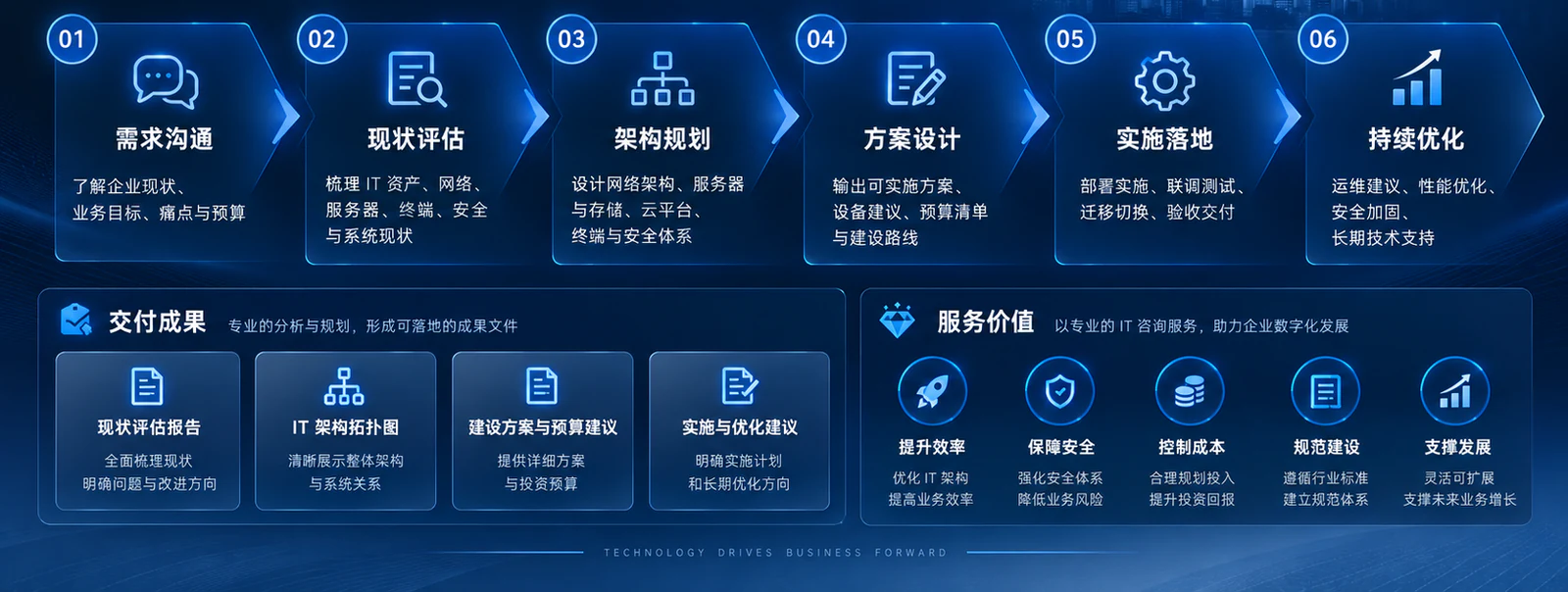
We review the current state and business goals, define system and data boundaries, and turn them into architecture, selection and phased implementation guidance.
01Solve the decision problem first
Clarify the goal before deciding what to build
Bring the current state, business goals, budget window and operating ownership into one shared view before setting priorities.
Start with the current state, business goals and ownership boundaries. Put scattered purchasing, system-retention choices and delivery ownership into one decision frame; implementation, migration and long-term operations are confirmed separately.
Shared inputs create the planning basis
-
01
Scattered investment
Departments procure and maintain separately, leaving unclear boundaries and priorities that make it difficult to turn budget into a continuous result.
-
02
Systems lose business context
Selecting by product features alone can miss real processes, data ownership and working habits, leaving heavy manual work after go-live.
-
03
Delivery is hard to continue
Without architecture, dependencies, ownership and handover evidence, procurement, delivery, operations and expansion have to rediscover the path.
02PLANNING DECISION MAP
Three planning lines form one decision.
These are not three isolated consulting products. Business and informatization planning sets direction, system-level planning turns it into architecture and delivery, and data-resource management keeps information governed, maintainable and useful across systems.
Business goals · existing systems · data ownership · delivery window
Strategy / blueprint / priorities
Architecture / selection / roadmap
Standards / ownership / collaboration
Architecture boundaries · priorities · roadmap · handover basis
Business, systems and data are checked in parallel; the map shows relationships, not a fixed project order or budget promise.
 IT consulting and planning · service overviewView cropped image ↗
Decision baselineFrom goals to architecture
Four decision actions connect strategy, business and implementation.
- 01Strategy and business goals
Understand strategy, operating processes and the business stage that IT needs to support.
- 02Business blueprint
Connect the operating blueprint with the IT blueprint so planning stays grounded in real operations.
- 03System architecture and selection
Use requirements, architecture and system dependencies to form a comparable build direction.
- 04Implementation strategy
Turn priorities, budget and delivery windows into phased build and handover decisions.
03THREE PLANNING LINES
Three lines, each scoped and cross-checked.
These are not three isolated consulting products. Business and informatization planning sets direction, system-level planning turns it into architecture and delivery, and data-resource management keeps information governed, maintainable and useful across systems.
Business and informatization planning
Connect enterprise strategy, the operating blueprint and IT goals to clarify why to build, what comes first and which business outcomes each phase must support.
- Enterprise and IT strategy interpretation
- Organization, process and business-blueprint mapping
- IT goals, scope and phase priorities
- Comparable development paths informed by industry benchmarks
Business blueprint, IT blueprint, target system and phased build priorities.
System-level planning and design
Start from business requirements and define requirements, architecture, application relationships and delivery planning so system build has clear boundaries, dependencies and selection rationale for procurement, delivery and acceptance.
- Business mapping, requirements and scenario priorities
- Application, platform, interface and infrastructure relationships
- System selection, build boundary, dependencies and migration strategy
- Delivery sequencing, testing, acceptance and operational handover
Target architecture, selection rationale, delivery roadmap, acceptance boundary and handover checklist.
Data-resource management planning
Reorganize the scattered data accumulated through years of system building as an enterprise resource, with shared rules, standard codes, ownership and multi-system use so data moves from “where it sits” to “how it can be trusted and used.”
- Data-resource catalog, classification and lineage
- Shared data rules, master data and standard codes
- Data ownership, maintenance and access mechanisms
- Data coordination paths for business and multiple applications
Data-resource catalog, standards and coding system, ownership model and cross-system coordination plan.
04ROADMAP / HANDOVER
Connect planning to implementation
Keep requirements, boundaries, dependencies, ownership and priority visible during planning so procurement, system delivery, testing, go-live and operations share a baseline and can assess change impact quickly.
- 01Baseline
Inventory systems, assets, processes and ownership boundaries.
- 02Design
Design the target architecture and priorities around maturity, requirements and dependencies.
- 03Implementation guidance
Turn selection, build cadence, testing and handover into actionable guidance for the next project; it does not replace execution or go-live testing.
- 04Planning review
Review feasibility against business scenarios, operating conditions and handover needs, then record adjustments; no go-live test is implied.

handover resultPLANNING ASSETS
Leave planning assets that can continue into delivery
Planning work is retained as a baseline record, business blueprint, architecture and selection rationale, implementation roadmap and handover strategy; the final scope is confirmed against the actual environment, requirements and available resources.
- Business blueprint and IT goals
- System architecture and selection rationale
- Data rules and resource-management model
- Phased implementation and handover strategy
Purchasing, configuration, development, migration and long-term operations are not assumed; confirm the service boundary against the current state, requirements and resources before proceeding.
05Common planning questions
Answer common questions during planning.
Start with existing systems, goals, key issues and timing; every condition does not need to be complete.
01Do we need a complete digital strategy before starting IT planning?+
No. A discussion can start from business goals, current systems, asset ownership, budget priorities and delivery windows.
02How does the planning work enter system delivery?+
The business blueprint, system architecture, selection rationale and phased strategy form the shared baseline for procurement, build, testing and operational handover.
03Should data-resource planning wait until all systems are built?+
It is better to define data rules, standard codes and ownership early so later systems can remain coordinated and maintainable.
Next step / planning assessment
Bring the current state, goals and the decision that is stuck.
Start with the systems, process, budget priority, timing or data coordination issue in front of you; we can confirm the next planning boundary together.
The planning scope is confirmed against the current state, requirements and resources; planning is not an automatic implementation, migration or operations commitment.