
The expensive part of training content is often not writing the first draft. It is revising the outline, slides, questions, and interactive steps every time a product, process, or compliance requirement changes. When an enterprise starts by asking for a platform that “automatically generates the entire course,” it usually discovers that material rights, output quality, and acceptance ownership are still undefined.
A safer starting point is one low-risk sample course: its sources are traceable, it can be played, its outputs can be edited, its factual errors have an owner, and the team can state what the system is not allowed to decide automatically. This guide is based on the OpenMAIC official repository, the v1.0.0 release, the root LICENSE, and the official README.
OpenMAIC was not installed on this machine, no real model was configured, and no production course file was generated locally. Commands, capabilities, and version details below are an official-source snapshot; the target environment still needs its own acceptance test.
01 Define the result the enterprise must accept
The acceptance target is not how many words a model produced. It is whether a course deliverable can be owned by the business team. Fix four results for the first sample:
- the learner and course objective are explicit rather than expanded by the system;
- every critical fact, process, and question has a source or human confirmation;
- the course plays, the slides or page can be edited, and the version can be rolled back;
- someone owns the pause and rework decision when a fact is stale, a source is unclear, or a permission is missing.
Without these results, more generated content only makes approval and accountability harder.
02 What OpenMAIC can do
OpenMAIC is described by its official materials as an open-source AI platform for turning topics or documents into interactive classrooms. The README describes course content, slides, quizzes, simulations or interactive content, and editable .pptx plus interactive .html outputs. The v1.0.0 release also records a Pro agent workbench, durable sessions, session materials, and built-in skills.
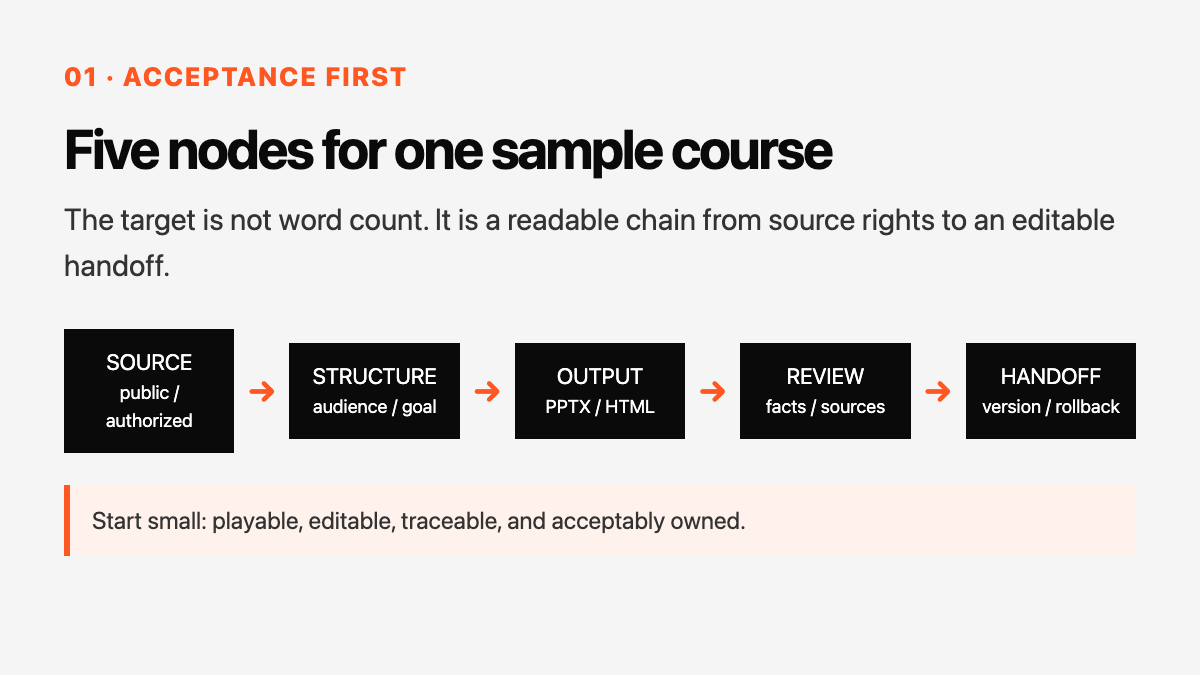
In an enterprise workflow, treat that as a chain of owned deliverables:
- Material input: use only public, authorized, and redacted sources;
- Course structure: fix the audience, objective, chapters, and acceptance points;
- Interactive output: generate a sample slide deck, quiz, or interactive page;
- Human review: check facts, references, questions, and brand language;
- Editable handoff: deliver the PPTX/HTML with a source table and revision record.
The point is not to hand every decision to an Agent. It is to leave a readable artifact at every step.
03 Follow the official deployment path
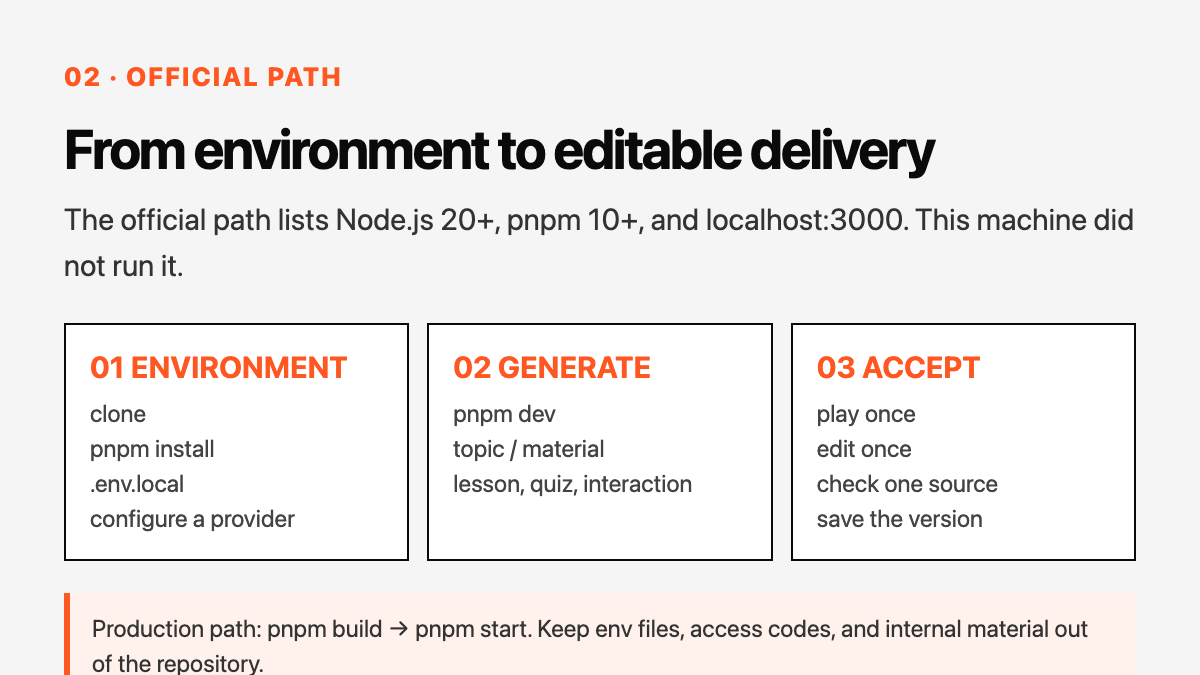
The official README gives a minimum development path with Node.js 20+ and pnpm 10+: install dependencies, copy the environment example, configure at least one model provider, and start the development service:
git clone https://github.com/THU-MAIC/OpenMAIC.git
cd OpenMAIC
pnpm install
cp .env.example .env.local
pnpm dev
The documented quick-start entry point is http://localhost:3000. The production path is:
pnpm build
pnpm start
The README also documents Docker Compose and server-side persistence. Before an enterprise deployment, put Node, pnpm, model providers, the database, access codes, and backups into an environment sheet. Do not commit .env.local, access codes, or internal material to the repository.
These are official instructions, not local test results. A proper acceptance record should keep the version and lockfile, configuration inventory, startup receipt, sample files, source table, and one failure-handling record.
04 What the first sample should include
The minimum handoff does not need a complete course platform. Start with four items:
- one sample course around a single objective and public or authorized material;
- a table of audience, structure, sources, versions, and unresolved items;
- an editable PPTX or HTML file the enterprise can continue to revise;
- one human review and revision record stating who changed what and why.
During acceptance, do not only play the first slide or inspect a screenshot. Sample one fact, one quiz item, one interactive step, and one edit, then verify that the export opens on the target devices. Continued editability is closer to deliverable value than generation speed.
05 Validate the next step in seven days
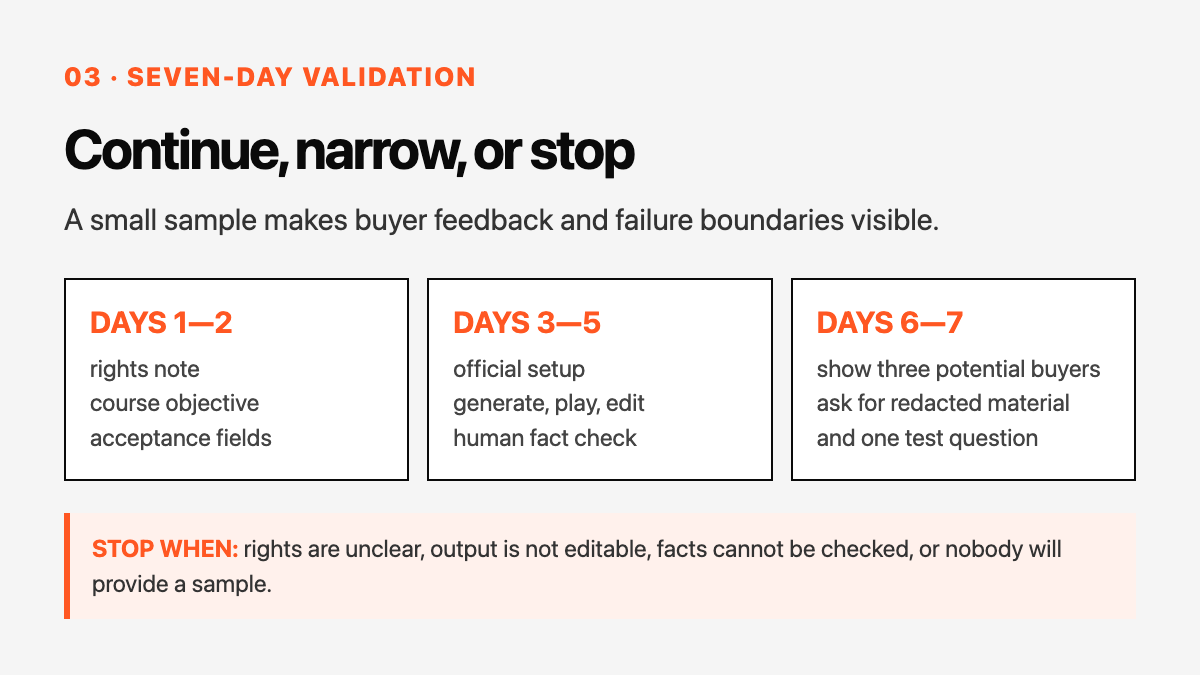
Seven days is a risk-limiting validation cadence, not a production launch promise:
- Day 1 | Select material: choose one public or authorized set; keep the unique objective, exclusions, and rights note.
- Day 2 | Define acceptance: fix the audience, chapters, questions, and acceptance fields; keep business-owner confirmation.
- Day 3 | Prepare the environment: use the official Node, pnpm, and provider path; keep version, configuration, and startup receipt.
- Day 4 | Produce the sample: generate one sample and export PPTX/HTML; retain the original input, version, and output.
- Day 5 | Review the result: play, edit, and fact-check the sample; keep the issue list, sources, and revision log.
- Day 6 | Test demand: show it to three potential buyers; record whether they will provide redacted material and one test question.
- Day 7 | Decide: continue, narrow, or stop; write down the owner, next action, and stop reason.
If nobody will provide redacted material or define acceptance for one sample course, stop at the sample. Validate demand and ownership before expanding data access.
06 Write the failure boundaries first
First, model, image, speech, and search providers may add separate costs; open source does not make the entire runtime free. Second, textbooks, question banks, brand assets, recordings, and employee information need rights, redaction, retention, and deletion rules. Third, self-hosting does not automatically prove that data stayed within company control: providers, logs, object storage, databases, and backups need separate review.
Fourth, do not inspect only the repository root license. OpenMAIC is MIT at the root, but packages/mathml2omml is marked LGPL-3.0-or-later, and bundled third-party terms require review before packaging, modification, redistribution, or a closed delivery. This is an engineering warning, not legal advice.
Fifth, generation is not factual correctness. Without human review, a source table, version history, and a named stop owner, do not hand the course off as a production-ready asset. When material is stale, facts conflict, the output cannot be edited, or permissions are unclear, record “needs review” rather than “complete.”
07 Four checks for the project owner
- Materials and rights: Are sources, permissions, redaction, and deletion timing confirmed?
- Environment and cost: Does someone approve Node, pnpm, model/multimedia providers, database, access codes, and backups?
- Results and review: Are the objective, source table, editable output, fact sample, and human review recorded?
- Shutdown and handoff: Are versioning, rollback, error handling, owner, and stop conditions written down?
Service boundary
Shanghai Yuqi Intelligent Technology Co., Ltd. can help businesses in Shanghai and nearby areas define the boundaries of training materials and standard operating procedures, build a low-risk course sample, organize source and acceptance records, and decide which steps are suitable for local generation or workflow improvement. The target system, identity, data permissions, third-party terms, and delivery scope remain subject to company approval, official documentation, and target-environment testing.