
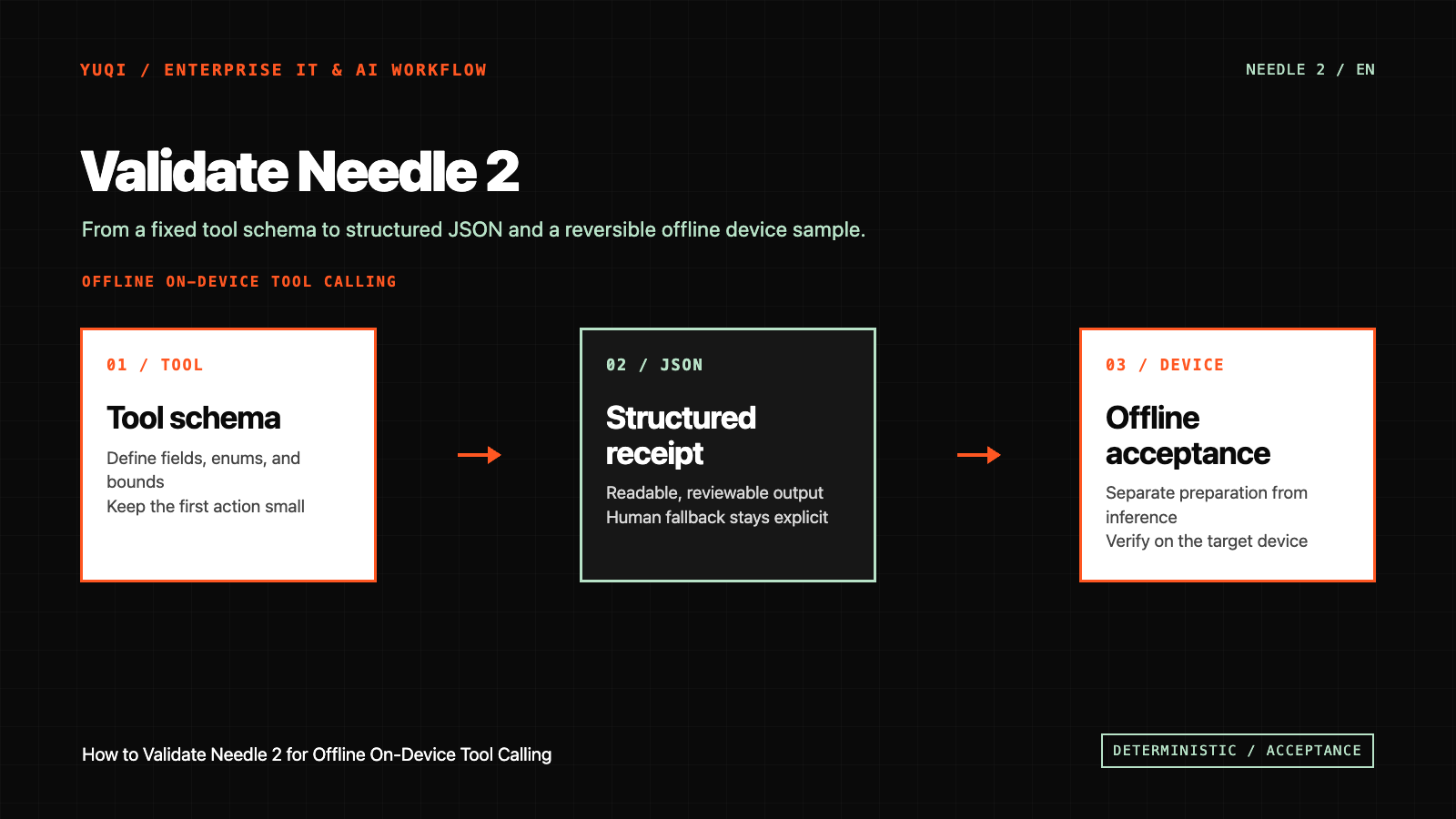
When a business adds AI to a device, store system, or local application, the difficult question is rarely whether the model can chat. The real questions are whether the device can carry it, whether the workflow keeps working when the network is unavailable, whether fields are constrained, whether an action gets human approval, and whether the system can fall back safely. The Needle 2 on-device tool calling model turns those questions into a small validation object, but it does not remove the acceptance work.
This article focuses on one bounded path: validate one fixed tool, one structured JSON response, and one device acceptance record for a repair, inventory, or sensor workflow. Needle 2 was not installed or run on this machine. The official size, memory, speed, and capability descriptions are not local benchmarks.
01 Start with a bounded enterprise problem
When a store network becomes unstable, a device feature may stop. A warehouse may need one inventory lookup but still send the request to a cloud service. A technician may describe a fault in plain language and receive prose that must be copied into a ticket. For a small or midsize business, delivery depends on whether this small workflow can be read back on the target device, not on how much attention a model release receives.
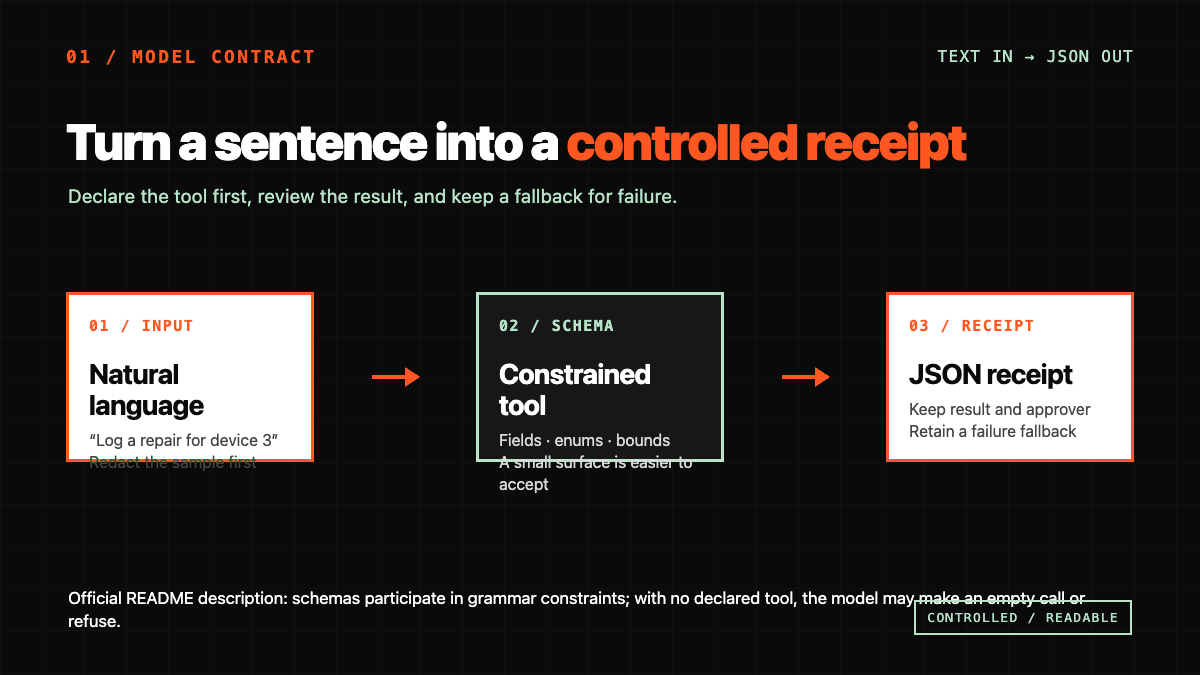
A useful first scope is one natural-language input, one constrained tool, a fixed set of fields, and a human approval point for writing or controlling actions. This makes the AI feature a deliverable with a clear input, result, owner, and fallback.
02 What the official materials say
The official Needle 2 README describes a 45M-parameter model for tool calling, device use, and structured extraction. It also describes the whole model as a single binary of about 14MB and a full session using about 28MB of RAM. These are project-reported figures, not measurements on a target device and not a compatibility promise for every device.
The intended interaction is not unrestricted chat. Tools and their parameters are declared first; the model chooses whether to call one; the tool result returns to the loop; and the response remains structured. The README also describes byte-level grammar constraints compiled from schemas, tool retrieval, confidence, and a 256-token sliding window. The fit is strongest for a small tool surface, explicit fields, and controlled actions.
As of 2026-09-04 08:50 +0800, the GitHub repository snapshot showed 10,188 stars, 654 forks, and an Apache-2.0 license. The repository had a September 3 commit supporting multiple Needle engine generations, and the official model card was also updated that day. “Latest” here means the timestamp checked for this article, not a universal ranking.
03 Follow the official path before training
The official Python package is cactus-needle. Its pyproject.toml requires Python 3.9 or newer, while the training stack is optional. The shortest official installation path is:
python3 -m venv .venv
source .venv/bin/activate
pip install cactus-needle
The README then shows a function decorated with @needle.tool, a needle.Needle(tools=[]) agent, and an agent.run() call. The expected result is a structured response containing executed tool results. The runtime still obtains and caches an engine from Hugging Face on first use. An air-gapped device therefore needs the official offline preparation path before inference.
This is an official executable path, not a local test result. A real delivery record should also capture the target architecture, Python version, available memory, package source, first-run network requirement, and fallback behavior.
04 Define the first deliverable
Do not begin with an “enterprise universal assistant.” Reduce one action to five items:
- An approved or redacted input: record its source, purpose, sensitivity, and test scope.
- A fixed tool schema: define fields, enums, required values, and numeric bounds; keep the first tool surface small.
- A structured receipt: retain device ID, symptom, time, priority, and next action as JSON.
- A human approval point: reading can be automated, but control and write actions should be confirmed.
- A device acceptance record: capture version, model source, engine preparation, offline behavior, failure cases, and fallback.
This sample could become a focused pilot for a device, store, or local-system team. The sellable object is a fixed-function integration and acceptance result, not the number 45M. There is no customer, order, quote, or revenue evidence in this run; this is a delivery hypothesis.
05 “Offline inference” has several paths
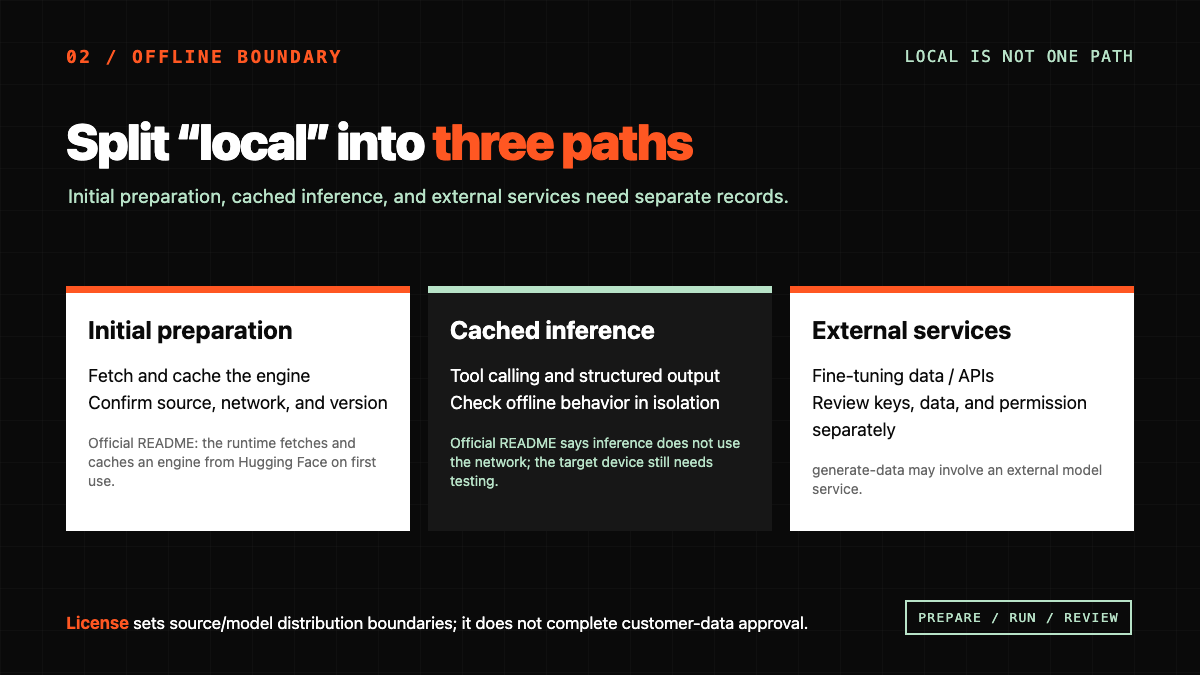
The official README says inference performs no network access while also explaining that the runtime fetches and caches an engine from Hugging Face. These statements should be kept together. Initial preparation, model or engine distribution, fine-tuning data generation, and external interfaces must be recorded separately rather than covered by the word “local.”
For a prepared tool-calling sample, test whether the inference phase works in an isolated environment. If generate-data is used, the official command involves OPENROUTER_API_KEY, which is an external-service path; no key was configured or used for this article. The source repository and official model card state Apache-2.0, but upstream components, customer-data permission, and industry controls still need separate review.
Common failures are not limited to crashes. With no declared tool, the model may make an empty call or refuse. A vague schema does not make the structured result business-correct. Official benchmark, speed, and RAM claims do not replace target-device testing.
06 Use seven days for a small acceptance test
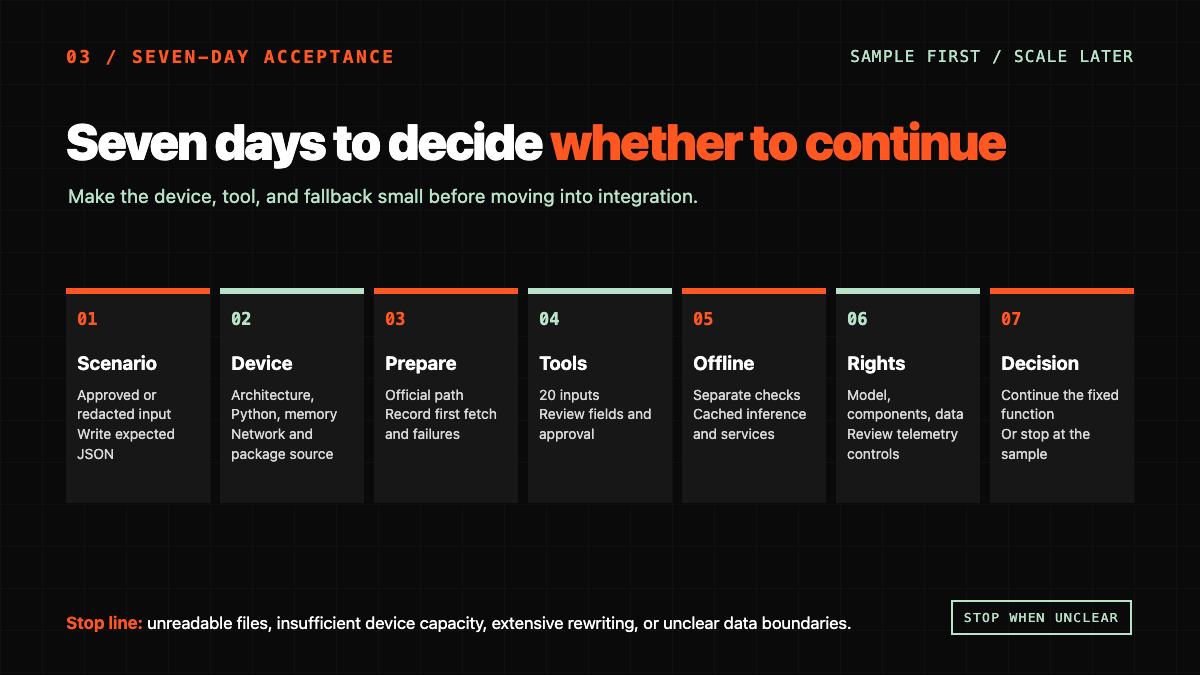
On day one, choose an approved or redacted scenario and write the input, tool, and expected JSON. On day two, confirm the device architecture, Python version, memory, disk, network, and package source. On day three, prepare the runtime through the official path and record engine acquisition, permissions, and failures. On day four, use 20 redacted inputs to inspect tool selection, field boundaries, and human approval. On day five, separate cached inference from external-service behavior in an isolated or offline condition. On day six, review the source, model, upstream dependencies, customer-data permission, and telemetry controls. On day seven, let the owner decide whether to continue with this fixed function or keep the sample and stop.
If a key file cannot be read back, the device cannot carry the runtime, the tool result needs extensive manual rewriting, or the data and license boundary is unclear, stop at the redacted sample. An official path that can be followed is not the same as an enterprise deployment.
07 Set the owner’s acceptance boundary
The owner only needs to confirm four things: whether the target device can carry the runtime, whether the first tool and field set are small enough, whether model, source, upstream components, customer data, and external APIs have documented permissions, and who reviews the 20 inputs, offline behavior, structured JSON, and final fallback.
Needle 2 is interesting because it turns a “latest model” discussion into a small problem that can fit on a device, return a fixed structure, and have a written stop condition. Prove a reversible sample first, then discuss more tools, larger models, and deeper system integration.