
Industrial Enterprises and Digital Transformation
The industrial Internet brings next-generation information and communications technology (ICT) together with manufacturing. With data at its core, it connects production elements across the industrial chain and value chain, supporting new manufacturing models and industrial ecosystems. The source describes it as an important foundation and route for digital transformation.
Industrial Transformation as an Opportunity
The source characterizes the industrial Internet as an industry whose market structure was still taking shape and whose adoption was entering a period of expansion. It argues that China's institutional and market conditions, together with promotion and development work led by the Industrial Internet Industry Alliance under the guidance of the Ministry of Industry and Information Technology, could help Chinese manufacturers lead implementation practice. This is a description of the article's original context, not a current market assessment.
Intelligent Optimization and Decision-Making
Data feedback loops are central to the industrial Internet model described here. Physical assets are sensed in depth, industrial data is integrated and managed, and industrial and data models are built and analyzed. The resulting optimization decisions are then fed back to physical systems. The source presents this loop as a basic method for applying intelligence to manufacturing.
Quality, Cost and Efficiency
Industrial Internet work should follow the realities of industrial operations and be driven by specific business scenarios. The source emphasizes the familiar goals of improving quality, reducing cost and increasing efficiency, with value demonstrated in the customer's operations.
Challenges
Disconnected business systems and fragmented data. Many enterprise systems are built as separate projects, leaving information isolated across production and business processes. Data also comes from different sources, including equipment, applications and video or other media. Collecting and bringing these sources together is a foundational challenge.
Legacy business architecture and limited evolution. The source points to ISA-95 as a framework originating in the 1990s and argues that legacy architectures may constrain full-factor sensing, integration, intelligent decisions and flexible expansion. It asks how IT, communications technology (CT) and operational technology (OT) can be integrated through an open, extensible architecture. Treat this discussion as the source's historical framing; assess any current architecture against the environment in scope.
Industrial modelling without suitable tools. Industrial software depends on accumulated industrial knowledge being expressed as models, turned into software and refined through use. The source says that without suitable platforms and tools, some Chinese manufacturers have delivered project-specific customizations rather than turning that knowledge into reusable products.
Skills and cross-disciplinary capability. Industrial Internet transformation combines industrial and information technology with cross-domain innovation. The source notes that it can be difficult for industrial companies to recruit and retain all of these capabilities internally and recommends cooperation between manufacturers, ICT companies and their ecosystems.
Solution Scenarios
- Industrial data lake
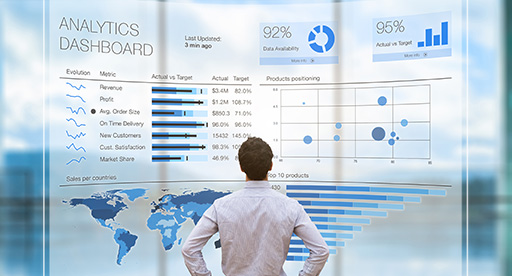
Because production and business systems contain isolated data from equipment, applications and video or other media, the source calls for collection across multiple elements, sources and data types, followed by governance and analysis. It describes using Huawei Cloud's Data Governance Center (DGC) to model core industrial processes, build subject-area data stores and analyze key business indicators. In production processes, this supports real-time visibility into line operations; across value-creation processes, it supports visibility into upstream and downstream supply chains and enterprise-wide analysis for business decisions.
- Intelligent decision-making in production
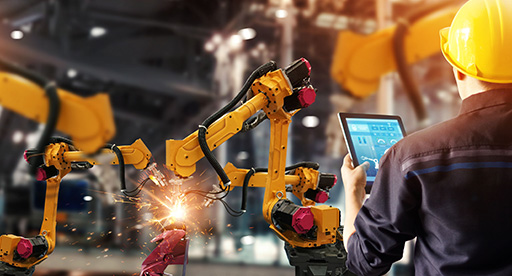
Industrial production involves multiple process steps, each of which may rely on process knowledge to recommend operating parameters. The source says that conventional process optimization has already been explored extensively, while data-driven AI can be useful for nonlinear problems involving multiple stages and system-wide optimization. It describes Huawei Cloud tooling for industrial AI development, including dataset management, process-knowledge and algorithm management, model-development and delivery pipelines, and visualization. The source says that combining process knowledge with data intelligence can improve model explainability and mentions exploratory work in steel, coal coking, chemical fibre and metallurgy. These are source-reported examples, not independently verified current deployments.
- Industrial vision
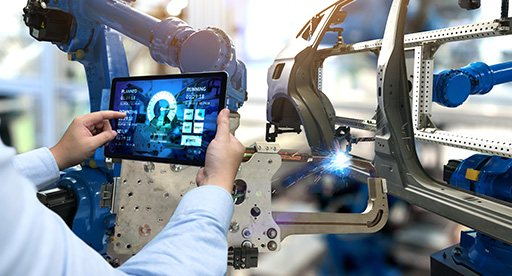
Industrial vision functions include recognition, positioning, inspection and measurement. The source lists applications such as product-quality inspection, sorting of randomly oriented parts, loading and unloading, depalletizing and palletizing, and adhesive application. It says these systems can improve inspection coverage and yield while reducing manual effort and the workload on quality inspectors.
Traditional machine vision is described as widely used in electronics and automotive manufacturing, but sometimes difficult to adapt because models are fixed and feature extraction depends on manual work. The source describes combining deep learning with an open application architecture to address these limits. It reports that the approach was intended for small-sample, multi-fault and multi-model inspection and for analyzing individual and interactive behavior. The source does not provide a reproducible evaluation protocol or current performance evidence; any present-day performance claim should be validated against an agreed sample set, operating conditions and acceptance criteria. It also names electronics, photovoltaic, lithium-battery and steel applications.
- Collaborative manufacturing
The source connects China's extensive supply-chain network with increasingly specialized production and more outsourced manufacturing. For a large company coordinating suppliers in multiple locations, a common requirement is real-time visibility into outsourced orders, end-to-end production tracking and in-process quality management. It describes a Huawei Cloud collaboration solution that brings together common MES, ERP and SCM applications for industry clusters and pre-integrates data and application interactions through ROMA and WeLink. The source says the approach was deployed with local-government partners in Suzhou, Changshu, Wuxi and Dongguan Songshan Lake; these are historical source-reported locations, not independently verified current projects.
Solution Architecture
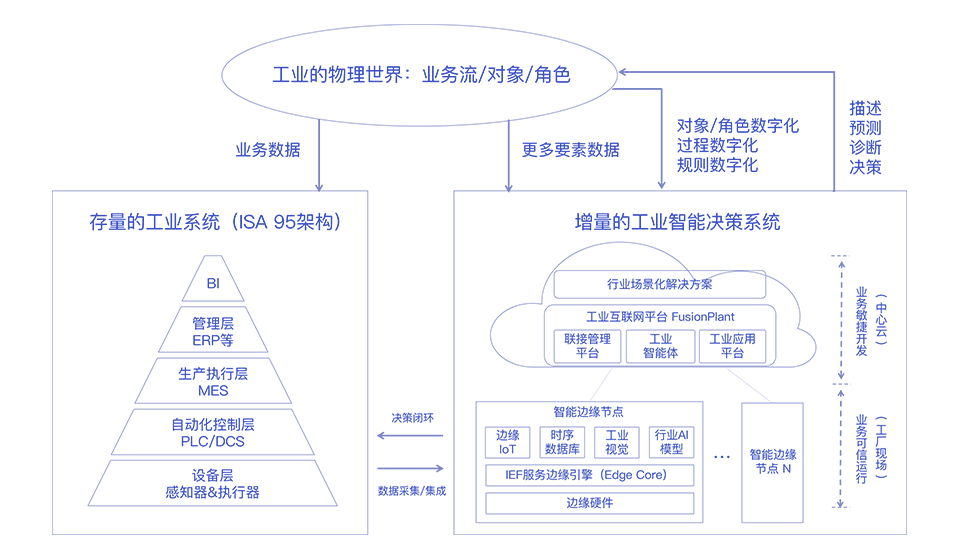
Industrial Internet Solution Architecture
The article describes FusionPlant as a Huawei industrial Internet platform with connectivity management, industrial agents and industrial applications. Its stated purpose is to support agile cloud development and trusted edge execution while helping partners work on core industrial processes. These platform descriptions reflect the source material; confirm current product availability and architecture with the vendor.
Architecture advantages
Yuqi Intelligent can assess an enterprise's current environment and discuss an industrial digital-transformation scope. For an initial review, see the English service catalogue or contact the team.