
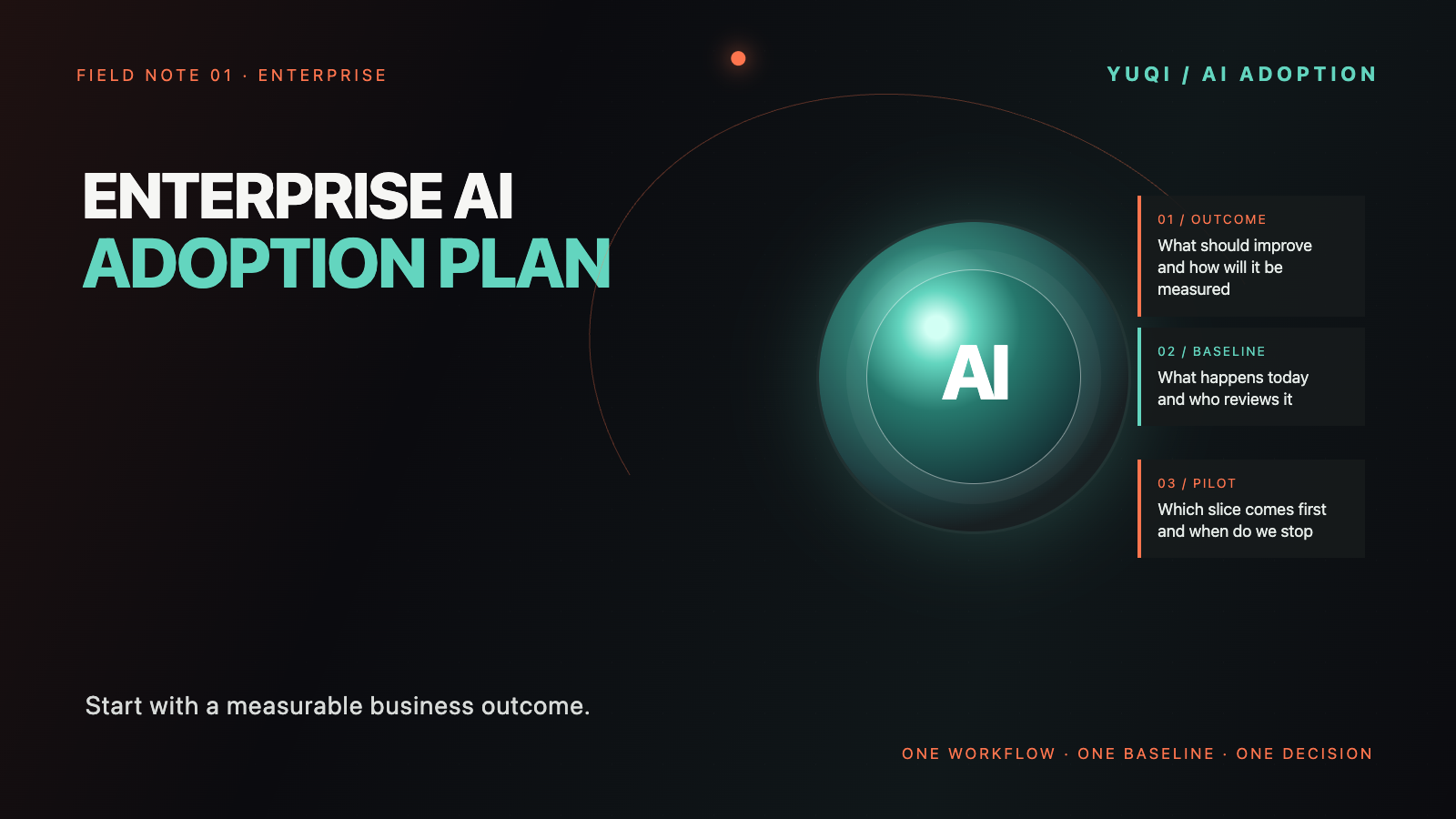
Many enterprise AI projects stall not because the model is too weak, but because nobody defines three management decisions: what should improve, what the current baseline is, and how the team will return to the existing process if the pilot fails. After several model changes, the business still has no comparable result and can only decide by intuition.
This enterprise AI adoption plan is for owners, managers and IT decision-makers at small and midsize organizations in Shanghai and nearby areas. It does not start from a model leaderboard or treat a vendor demo as a business result. It turns “should we expand AI use?” into a decision sheet that a project owner can actually run.
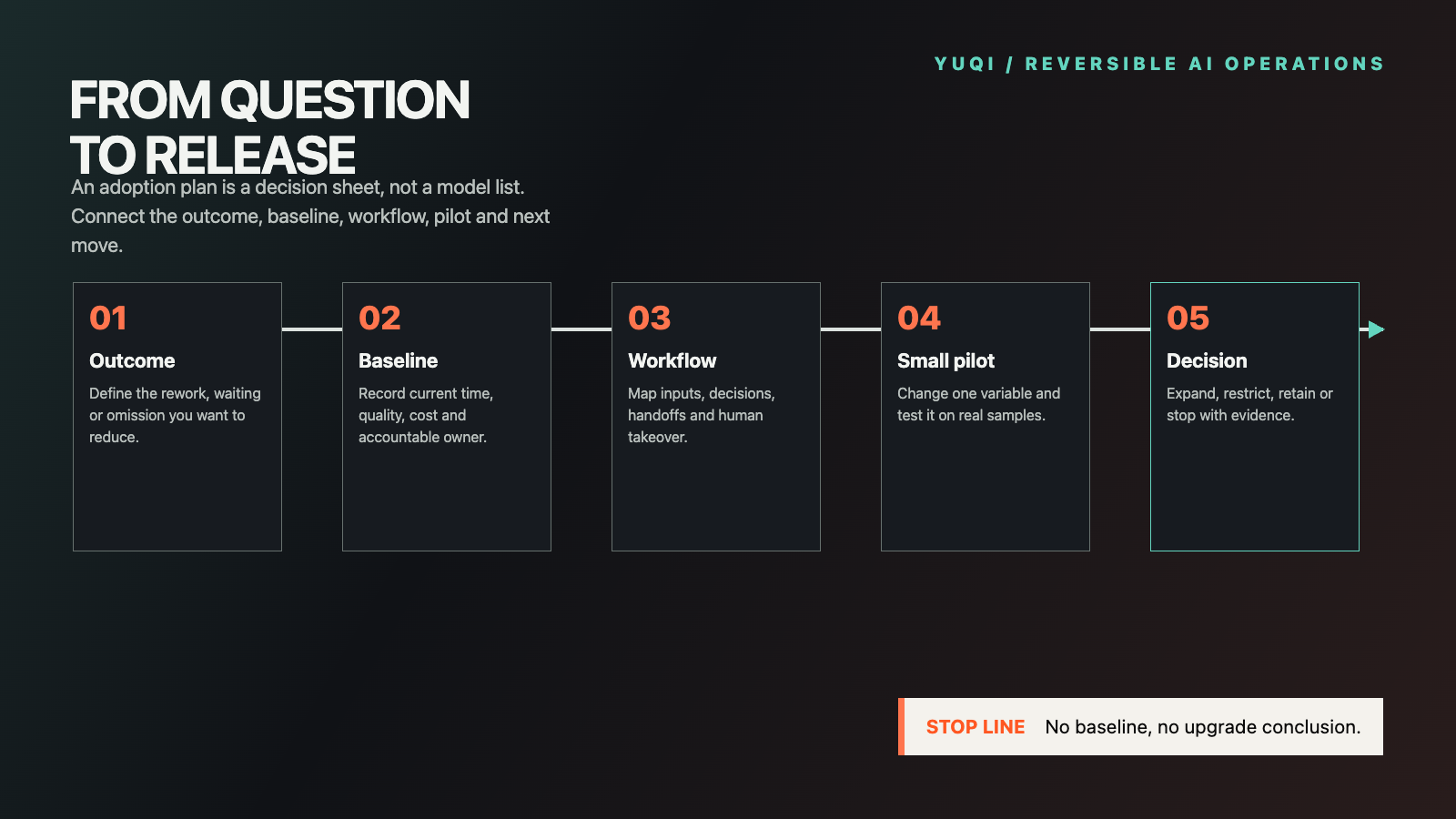
Define the business outcome before choosing a model
“We want to use AI” is not an implementation goal. A useful goal is visible to the business owner: reduce first-pass customer-service preparation time, deliver a sales draft sooner, shorten internal document searches, or remove repeated omissions from an IT inspection report.
Add three constraints to the goal: what must not be sacrificed, who judges the result, and when the next decision must be made. This keeps a project from becoming an indefinite trial based on “it feels convenient,” and prevents one awkward demo from disqualifying a useful workflow.
Capture the current baseline first
Keep at least one week of real process records: time per task, human edits, recurring errors, and where a person waits or reworks an item. Without a baseline, the team cannot distinguish an AI improvement from changes in workload or operator familiarity.
The first baseline does not need a complex data warehouse. For a small business project, task count, elapsed time, rework count, key-field accuracy and human review time are often enough to start a comparison. Minimize customer details, contracts and account identifiers according to the actual need; sanitize them before testing when possible.
Map the workflow to the next owner
Do not draw only “input → AI → output.” Mark where the material comes from, where a business decision occurs, who receives the result, which cases return to a person and which system stores the final outcome. A workflow may look automated while the real delay sits in confirmation and copy-paste handoffs.
Split the workflow into three layers: content AI can prepare directly, judgments an employee must confirm, and actions that remain outside AI for now. Data entry, system connections and account scope depend on the environment. Draw those boundaries before deciding whether integration or a new tool is necessary.
Run a small pilot instead of a company-wide trial
Keep the first round to one team, one workflow and one accountable reviewer. Prepare routine samples plus a small number of incomplete-input, formatting-error and human-intervention cases. Record several consecutive days rather than selecting only the best-looking outputs.
Change one major variable during the pilot: the model, the instruction set or one connected source. Record quality, rework, elapsed time, cost and human takeover. OpenAI's Path to Astra treats monitoring and safeguards as part of deploying high-capability systems; for an enterprise, that is a reminder that “can demo” and “can operate” need an observable pilot between them.
End the pilot with one of four decisions
Do not close the trial with “the results look good.” Choose one outcome:
- Expand. The target measure improved, exceptions are manageable, and the owner approves more roles or tasks.
- Restrict. Use the workflow only for selected roles or low-risk steps, with human review retained.
- Adjust. The direction is valuable, but the data, process or input quality needs correction first.
- Stop. Rework does not decline, results cannot be reviewed consistently, or cost and risk exceed the acceptable range.
Attach samples, the baseline, the accountable owner and the next review date to the decision. Even a stopped project then leaves reusable evidence instead of an account that was “tried” but cannot be explained.
What Yuqi can deliver
When a company is unsure where to start, Yuqi can help turn one business chain into handoff-ready material: a current-state process map, data and system inventory, pilot scope, acceptance sheet, human handoff points and an expansion recommendation. We do not promise model savings. We make the verifiable parts clear and transferable before deciding whether system integration or ongoing operations are needed.
If you are planning an enterprise AI pilot, workflow review or system connection, use Yuqi's enterprise AI adoption planning service to describe the current workflow, data scope, participating roles and desired outcome. The final scope depends on the environment and the work agreed by both parties.
Source: OpenAI Path to Astra. Prepared by Shanghai Yuqi Intelligent Technology Co., Ltd. with AI-assisted research, writing and official-source review. The diagram is a deterministic local technical graphic and contains no customer data, measured performance or vendor endorsement. Sources reviewed on September 14, 2026.