
Employees may use public AI to edit contracts, summarize customer information or organize meeting notes because it is convenient. But what they paste may include customer names, contact details, prices, technical plans, unpublished financial information or clues about internal accounts. A common mistake is to assume that because a tool is accessible and an employee has an account, the material is approved for upload.
The questions are whether the business is allowed to process the data this way, whether the amount shared exceeds what the task requires, and whether the service's terms, storage and administrative boundaries meet company requirements. Public AI is not automatically off limits, but “upload first and ask later” should not be the default.
This article does not give legal advice. It offers a low-risk management framework to help a business define data boundaries before deciding which tasks can use AI and which need an approved business tool or a human process.
Being able to sign in to public AI does not authorize data use
An employee's work access to a contract or customer list usually means they may use it for their job. It does not automatically mean the whole document can be sent to another external service. China's Personal Information Protection Law requires personal-information processing to have a clear and reasonable purpose, be directly related to that purpose, and use the minimum necessary scope; processing also needs an applicable legal basis.
China's Data Security Law requires data processors to establish lifecycle data-security controls and protect data through classification and grading. The Interim Measures for Generative AI Services also require providers to protect information and usage records submitted by users. These provider obligations do not mean a business may upload anything without review. The business still needs to assess its purpose, authorization, contract terms and sector requirements.
Requirements vary by business, data and service terms. For sensitive personal information, important data, confidentiality duties, cross-border processing or regulated sectors, the company's legal, data-protection or compliance owner should assess the actual facts. An article or an employee's personal interpretation is not a substitute.
Classify by impact, not just by filename
A file named “Meeting notes.docx” might contain only a public event schedule—or customer decision-makers, pricing limits and sales strategy. The filename does not define the risk. Ask whether improper access, retention or reuse could affect an individual's rights, customer relationships, contractual duties, business operations or system security.
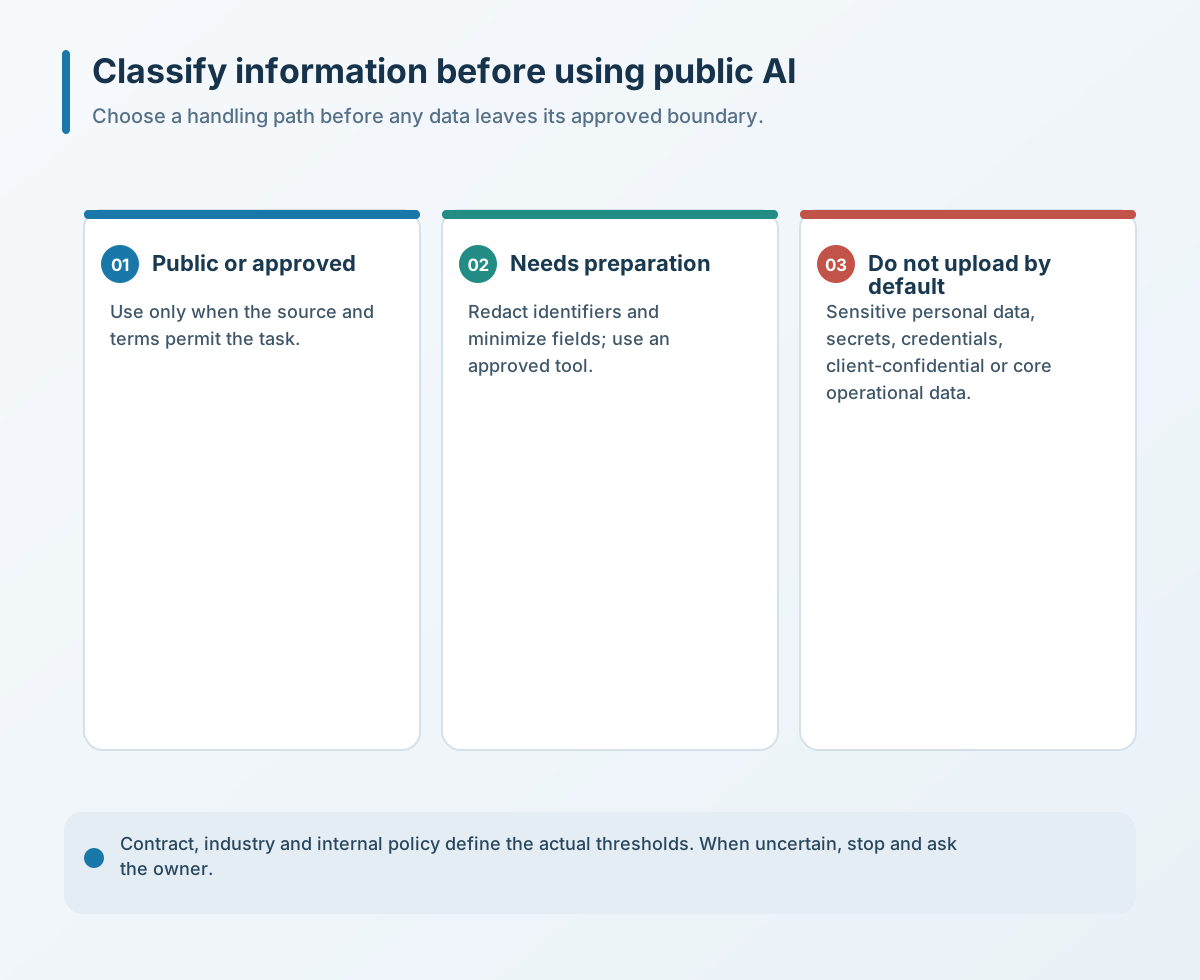
A business can start with three internal handling tiers. Green covers public information with no personal data or confidentiality duty that can be reused. Yellow needs reduction, de-identification or an approved business tool. Red covers items such as sensitive personal information, secrets, credentials, unpublished prices, confidential customer material or core business data; by default, it stays out of public AI.
These colors are a practical internal framework, not a legal classification prescribed for all organizations. Set a formal scheme against the Data Security Law, Personal Information Protection Law, contracts, industry rules and the company's own data inventory. The essential part is a usable stop point before upload, not memorizing complex statutory language.
AI can help with a task without receiving the entire source file
Many tasks need help with format, structure or wording—not the whole source. To improve a general contract clause, there may be no need to upload the full contract. To summarize interview themes, remove names, phone numbers, company names and exact prices first. To generate a spreadsheet formula, provide fictional field names and sample values.
The Personal Information Protection Law includes data-minimization requirements and calls for measures such as classification, access controls, encryption or de-identification. A practical translation for everyday AI use is simple: provide only what the current task needs. Share an excerpt instead of a full file, use placeholders instead of real identities, and use an approved environment instead of a personal account when available.
Removing a person's name does not necessarily anonymize the material. A customer ID, project, address, job title and surrounding context may still identify someone. Keep any re-identification mapping under control. For high-risk information, the safest action may be to stop rather than keep transforming it.
Tool approval must cover terms, permissions and exit
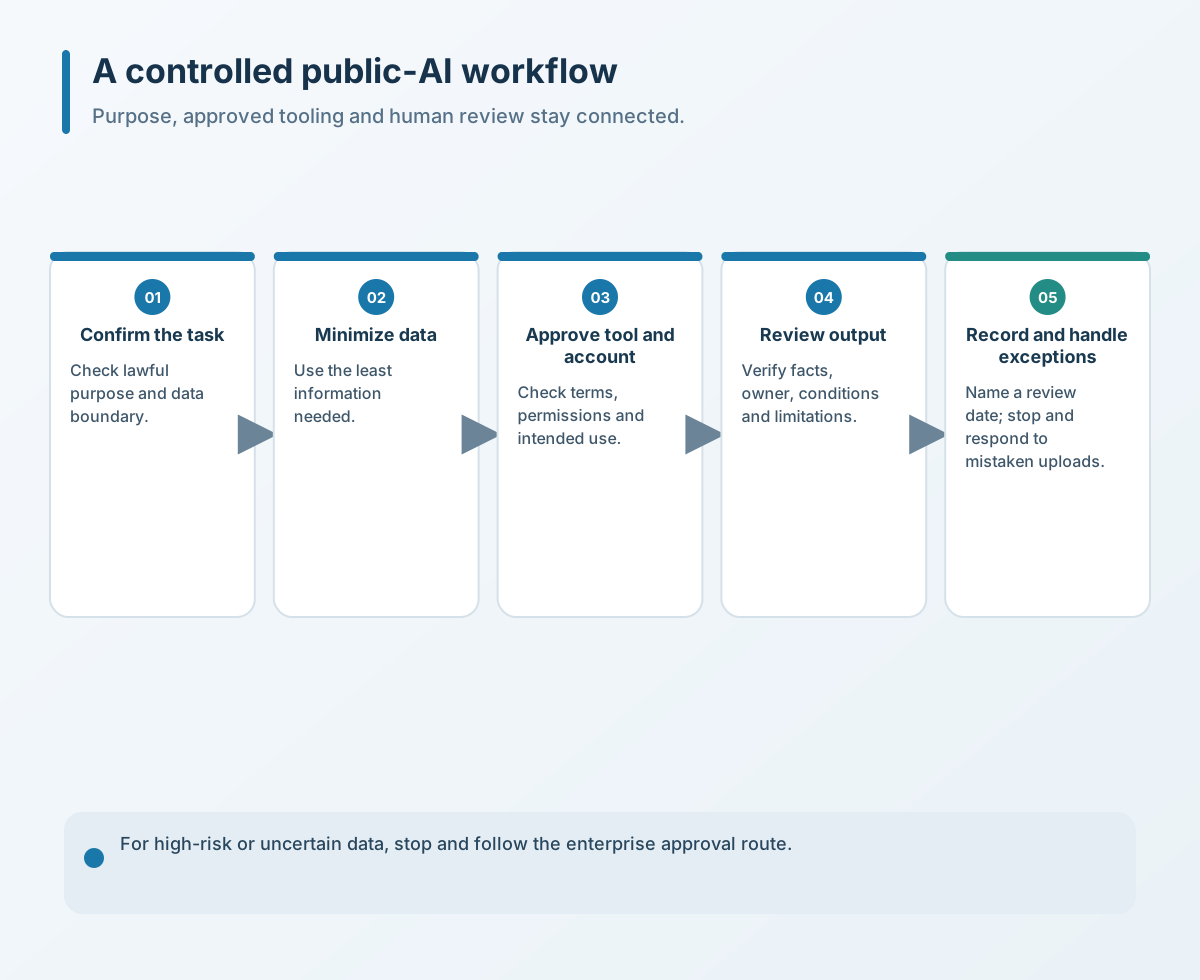
When evaluating an AI tool, do not look only at answer quality. Check whether inputs are used to improve the service, how long data is kept, whether administrators can manage accounts, how access is reclaimed after an employee leaves, whether business agreements, logs and deletion are supported, and whether the service region creates additional compliance needs. NIST's generative-AI risk-management material also notes risks to intellectual property, privacy and information security when integrating third-party generative AI.
Terms may differ between personal, team and enterprise editions of the same brand, and they can change over time. Record the data category, purpose, approved tool and account type, minimum fields, retention expectation, reviewer, exceptions, review date and incident-reporting path. “Keep it confidential” is not enough, and one approval should not remain valid forever without review.
People must also review AI outputs before accepting them as facts or using them to change records or make external commitments. A model may change numbers, conditions or responsibility language in a contract, quote, customer reply or policy. Keep the source, reviewer corrections and final decision together. Data security is the entry point; business responsibility remains with the organization and the final reviewer.
Four actions a business can take now
- List data that must not be uploaded. Start with passwords, keys, confidential customer material, sensitive personal information, unpublished prices and core operating data; put the list where employees can use it.
- Create minimization templates for common tasks. For contract editing, meeting summaries and spreadsheet work, specify what to remove, what can remain and when staff must stop.
- Approve specific service versions and accounts. Record the service, allowed uses, owner, review date and exit process. Do not make personal accounts the default business tool.
- Keep human review and incident reporting. A responsible person should check contracts, quotes, customer messages and policies; provide a path to stop, report and respond to an accidental upload.
A business does not have to abandon AI because data can be at risk, nor should it ask employees to guess the boundaries in the moment. Define prohibited data, minimization methods, approved tools and final review first; AI can then serve as a controlled work tool rather than an unmanaged data outlet.
If you need to adapt contracts, quotes or customer-information workflows for controlled enterprise AI or locally operated automation, contact Yuqi Intelligent to clarify data boundaries, approvals and human-review responsibilities.
Sources
- National People's Congress: Personal Information Protection Law of the People's Republic of China
- Cyberspace Administration of China: Data Security Law of the People's Republic of China
- Cyberspace Administration of China: Interim Measures for Generative AI Services
- NIST: Artificial Intelligence Risk Management Framework: Generative AI Profile