
Intrusion Alarm Systems
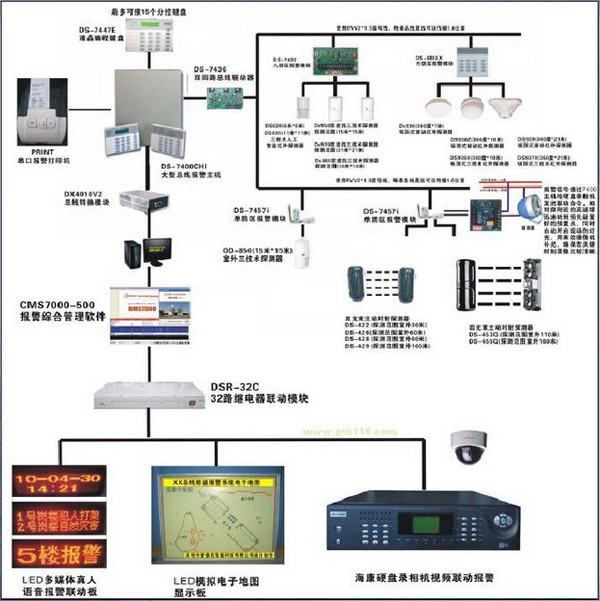
A surveillance system, also known as closed-circuit television (CCTV), typically includes front-end audio and video capture devices, transmission equipment, and back-end storage, control and display equipment. Back-end equipment can be divided further into central and distributed control devices. Depending on the design, the components may be connected by coaxial cable, twisted-pair cable, fibre, microwave or wireless links. An intrusion alarm system also needs an alarm control panel to process wired or wireless signals, detect system faults, manage power, accept inputs and issue outputs; some panels include a dialler. Front-end detectors may include door contacts, glass-break detectors, infrared detectors, combined infrared/microwave detectors, electric-fence sensors, external beam detectors and emergency-call buttons.

Current Situation Analysis
The Chinese source is an older overview; treat the technology examples below as historical and check product support, security controls and regulations for the current project.
It calls for more stable and reliable products, with better resistance to tampering, lightning-induced surges and interference. It also describes features intended to simplify installation and use, such as adjustable detector frequencies, configurable detection zones, anti-masking and tamper alerts, and wireless links between detectors and the control panel.
Other directions in the source include easier installation and commissioning; more intelligent zone management and voice prompts; biometric arm/disarm; sending images with alarms; remote control; and additional connectivity options beyond telephone lines, including IP networks, GSM/GPRS and dedicated VPN links.
The source also points to encrypted network communication and wired/wireless primary-and-backup paths for alarm delivery, as well as integration and expansion. Alarm outputs can coordinate with systems such as video surveillance and access control so that multiple security subsystems work together. Confirm which of these features are available in the selected current devices and how they will be tested.

System Advantages and Installation Considerations
As buildings use more surveillance equipment and organizations place greater emphasis on personal safety, comfort and property protection, intrusion alarms have become one of the representative parts of a broader security system.
The source notes that many intrusion detectors use individually wired connections to the control panel and zone expanders. This can limit system flexibility and make installation and commissioning more complex, increasing cabling and labour costs. It argues that these drawbacks are particularly apparent in perimeter-protection projects.
For larger commercial systems, the source identifies installation and maintenance effort—including wiring, programming and later field service—as project-selection considerations. Its comparison of traditional wiring approaches is not fully clear, but it emphasizes that connecting each detector independently can increase wiring complexity.
The article also describes bus-connected keyboards and an automatic-installation approach as ways to simplify deployment, reduce commissioning effort and cabling, and increase the distance between controllers. Treat these as design options to validate against the selected alarm platform rather than universal capabilities.

Alarm Types
The source lists telephone diallers, infrared alarms, sound-and-light alarms, surveillance cameras, infrared detectors, door and window contacts, infrared beam detectors, transformer-theft alarms, multimedia-message alarms, motion-triggered alarms, smoke alarms, fingerprint alarms, 5G alarm devices and remote monitoring. The original list repeats transformer-theft alarms; this translation removes that duplicate.
Yuqi Intelligent provides design and implementation support for intrusion alarm systems. To discuss scope or related security work, see smart security and access-control services or the English service catalogue.