
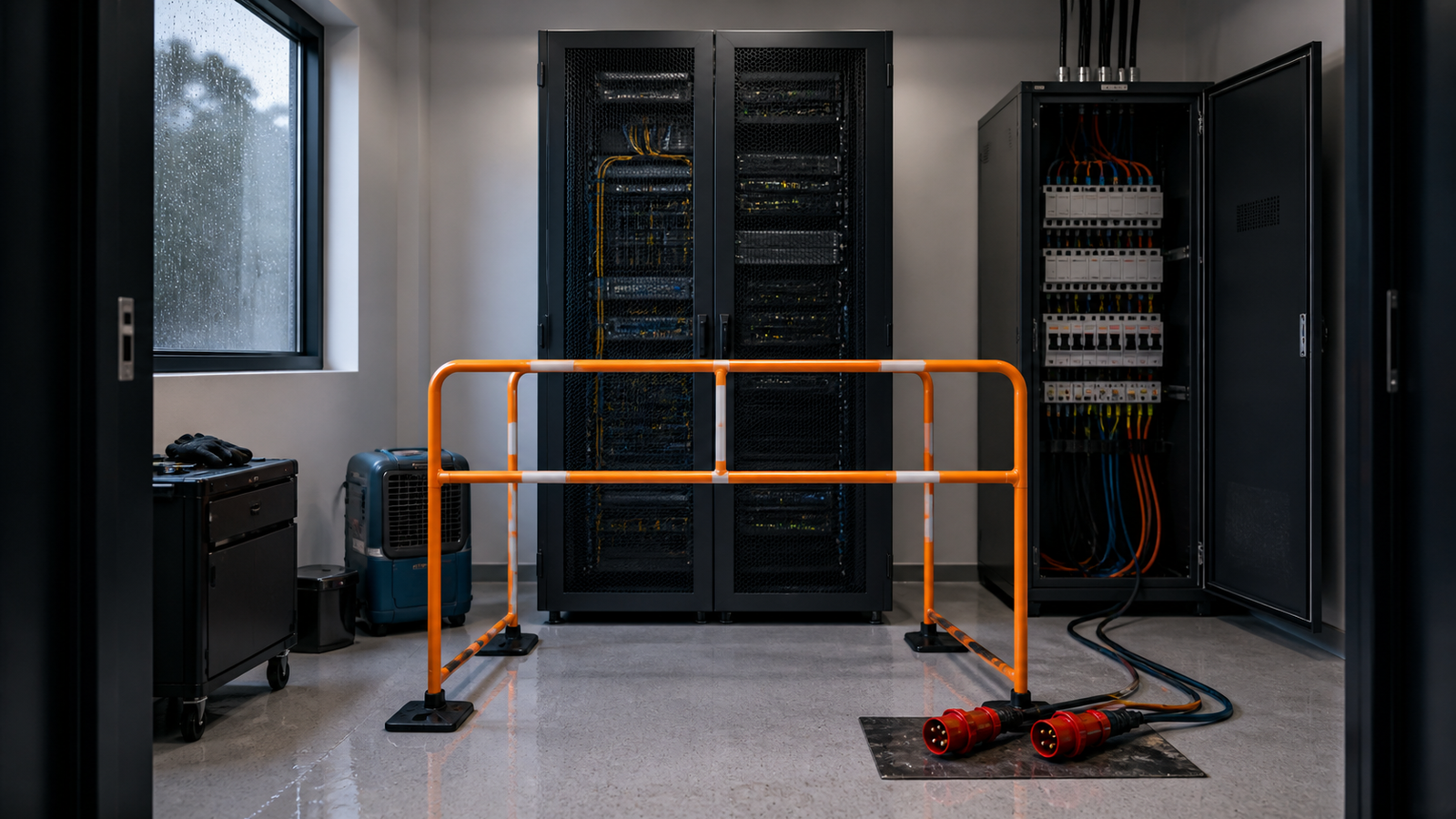
Why Damp Server-Room Equipment Should Not Be Powered On Immediately
After a typhoon or heavy rain, businesses naturally want offices and production systems running again. Once standing water has gone and equipment enclosures look dry, it can be tempting to energize the room and see whether the servers start. That is precisely where a controllable recovery can turn into a second incident. Moisture and contaminants may remain inside connections, insulation, power modules, cable pathways, or upstream electrical equipment.
This article is not a repair guide for ordinary employees. It explains the decision boundary: when a business must stop, arrange qualified inspection, and restore power only after the affected equipment and environment have been assessed.
Shanghai's practical message: inspect first, energize later
In a post-typhoon safety notice published on August 11, the Shanghai Fire and Rescue authority said that distribution boxes, electrical wiring, and production equipment exposed to standing water should be inspected by qualified electricians for insulation performance and short-circuit risks before power is restored.
The notice was written for public safety, but its logic applies directly to enterprise IT. Servers, storage, switches, and workplace systems all depend on electrical distribution, UPS units, PDUs, cabling, and a stable physical environment. Even when an IT device was not submerged, moisture in upstream distribution, outlets, trays, or the bottom of a rack can still create risk.
August 11 is the publication date of the notice; it does not imply that Shanghai is experiencing the same weather conditions today. The durable lesson for businesses is to make “inspect first, energize later” part of a recovery procedure rather than improvise after the next storm.
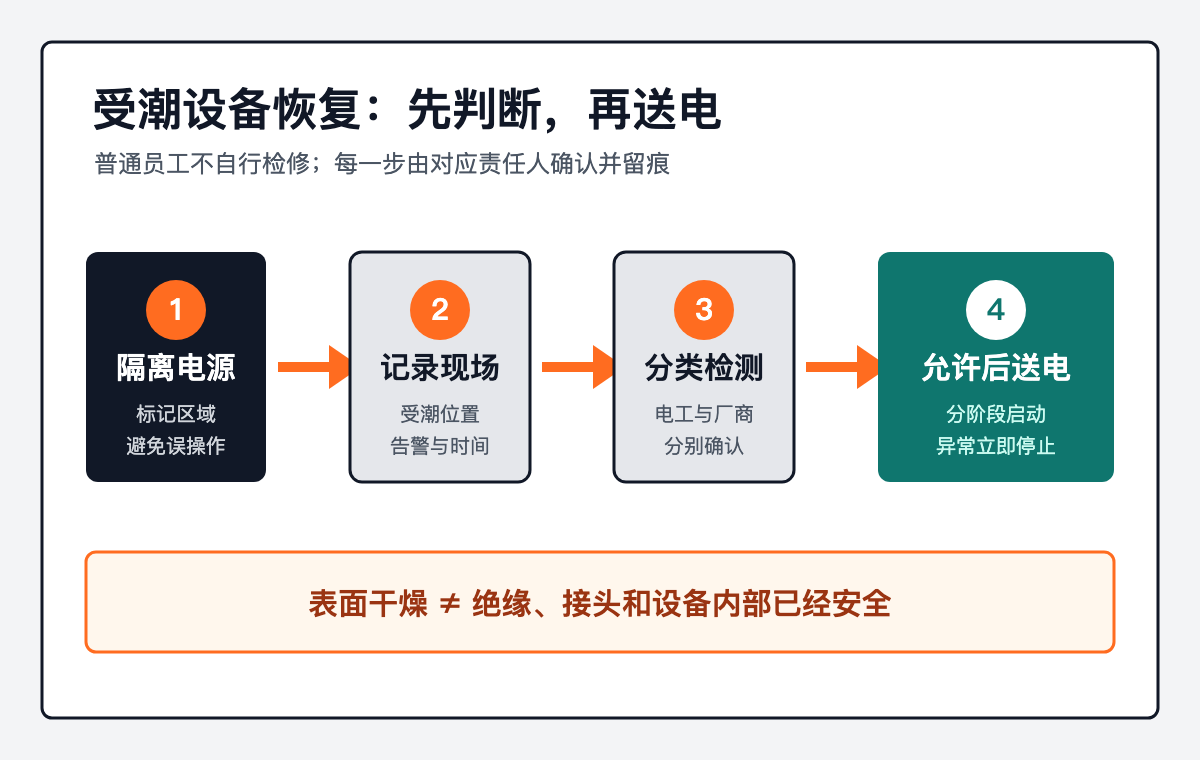
A dry enclosure does not prove internal safety
Water damage is not limited to visible droplets. Moisture and contaminants may enter connectors, switches, power modules, and insulating material. Possible consequences include short circuits, current leakage, corrosion, or protection devices that no longer operate as intended. Air-drying changes the visible condition, but it does not verify insulation performance or prove that internal contamination has gone.
NEMA's guide to evaluating water-damaged electrical equipment separates equipment that should be replaced from equipment that may be reconditioned after consultation with the manufacturer and assessment by qualified personnel. A business should not copy an overseas guide as if it were a local repair order. The useful principle is that different equipment categories require different decisions, and visual inspection or a one-time test boot is not enough.
Power distribution equipment and IT equipment should not be treated as one category. Switchgear, breakers, UPS systems, batteries, PDUs, servers, and network devices differ in construction, failure modes, and manufacturer requirements. One person should not apply one improvised method to all of them.
Rushing to power on reverses the recovery sequence
A controlled recovery starts with people and electrical safety, then verifies equipment condition, and only then starts business systems. Businesses sometimes reverse that sequence: they first check whether the ERP login works, then discover that a switch is down; they start servers before confirming the UPS and distribution path; or a newly restored system shuts down again because the power source remains unstable.
Repeated trial-and-error can also destroy useful evidence. The time and height of water exposure, the first alarms, and the order of protective trips all help qualified personnel understand what happened. Uncoordinated cable changes and repeated reboots make that record harder to interpret.
The recovery lead therefore needs two coordinated lists: an electrical and equipment inspection list, and a business-service priority list. No business urgency overrides the energization boundary before safety checks pass. Once equipment is cleared, services should return in stages according to dependencies across network, storage, hosts, applications, and endpoints.
A one-page responsibility register also helps. Put the area, equipment, current status, inspector, approver, and earliest permitted start time on the same line. Replace vague labels such as “handled” with explicit states: not inspected, awaiting vendor advice, repair and retest required, replacement recommended, or cleared for energization. Facilities, electricians, vendors, and IT staff then work from the same boundary, and verbal urgency cannot silently change an unresolved item into an approved one.
Where insurance, maintenance contracts, or colocation providers are involved, retain photographs, test conclusions, serial numbers, repair recommendations, and replacement records. After recovery, feed the findings back into the storm-readiness plan, including drainage, openings, cable routes, rack bases, and alarm locations.
Five actions a business can take first
- Isolate the affected area and power source. Do not let ordinary employees reset breakers, reconnect plugs, or repeatedly test equipment. Mark wet, damp, and potentially affected areas.
- Document the scene before removing all evidence. Record water locations, exposure height, alarms, trips, discovery time, disconnection time, and actions already taken.
- Assign the right qualified party to each equipment category. Electrical distribution and wiring need qualified electrical assessment. UPS, server, storage, and network equipment should be handled according to vendor requirements.
- Protect data and configuration continuity. Confirm that backups, network configuration, recovery records, licenses, and account access are available before replacing or rebuilding equipment.
- Restore in controlled stages. Verify power and environment first, then core network, storage and hosts, applications, and finally endpoints. Record each result and stop expansion immediately if an abnormal condition appears.
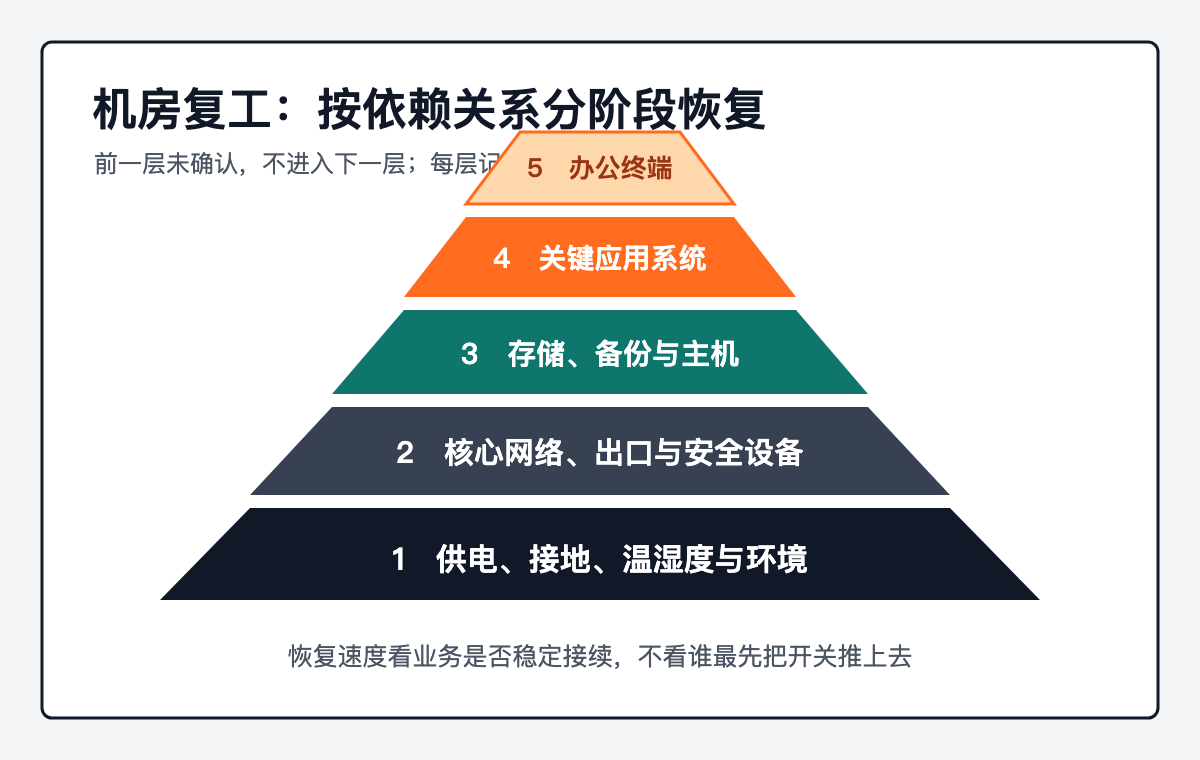
Fast recovery is not measured by who flips the switch first. It is measured by whether the business returns without creating another incident. If there was water ingress, a protective trip, unusual odor, unexplained alarm, or moisture of uncertain origin, inspection must replace guesswork.
If your business needs to assess moisture risks across a server room, electrical distribution, UPS, servers, storage, and network equipment, contact Yuqi Intelligence. Start with the safety boundary and critical-service priorities before deciding the recovery plan.
Sources
- Shanghai Municipal People's Government, post-typhoon fire safety notice: <https://www.shanghai.gov.cn/nw17239/20260812/741b469967bd4c398a4007b8b0cbe75a.html>
- Shanghai Municipal People's Government, enterprise safety reminder after a typhoon: <https://www.shanghai.gov.cn/nw17239/20260811/4930f4591c19452ea19150054ccf40b4.html>
- NEMA, Evaluating Water-Damaged Electrical Equipment: <https://www.nema.org/docs/default-source/secure-document-library/nema-gd-1-2016-evaluating-water-damaged-electrical-equipment-guide.pdf>