

Business continuity planning
Business continuity management
Impact and dependency analysis, response roles and exercises for priority services.
Continuity operating brief
Define the minimum operating level
Start from critical services, dependencies, tolerable disruption, alternate procedures and recovery priorities, then connect backup, disaster recovery, availability and team coordination into an exercisable continuity plan.
Continuity planning starts with business impact analysis. Customer, order, payment, production, collaboration and regulatory processes have different outage impacts and cannot share one recovery target or technical response.
Define peak periods, maximum tolerable outage, data-loss window, minimum operating level and business owner for each critical service.
- Business impactAssess revenue, customer, production, compliance and reputation impact.
- Time targetsDefine maximum tolerable outage, RTO and RPO.
- Minimum operating levelConfirm the people, systems and steps required during disruption.
02 / Dependencies and strategy
A single point is not only hardware
Critical services depend on more than servers. Missing identity, network, DNS, workspace, telephony, data, third-party interfaces or key people can block operations after technical recovery.
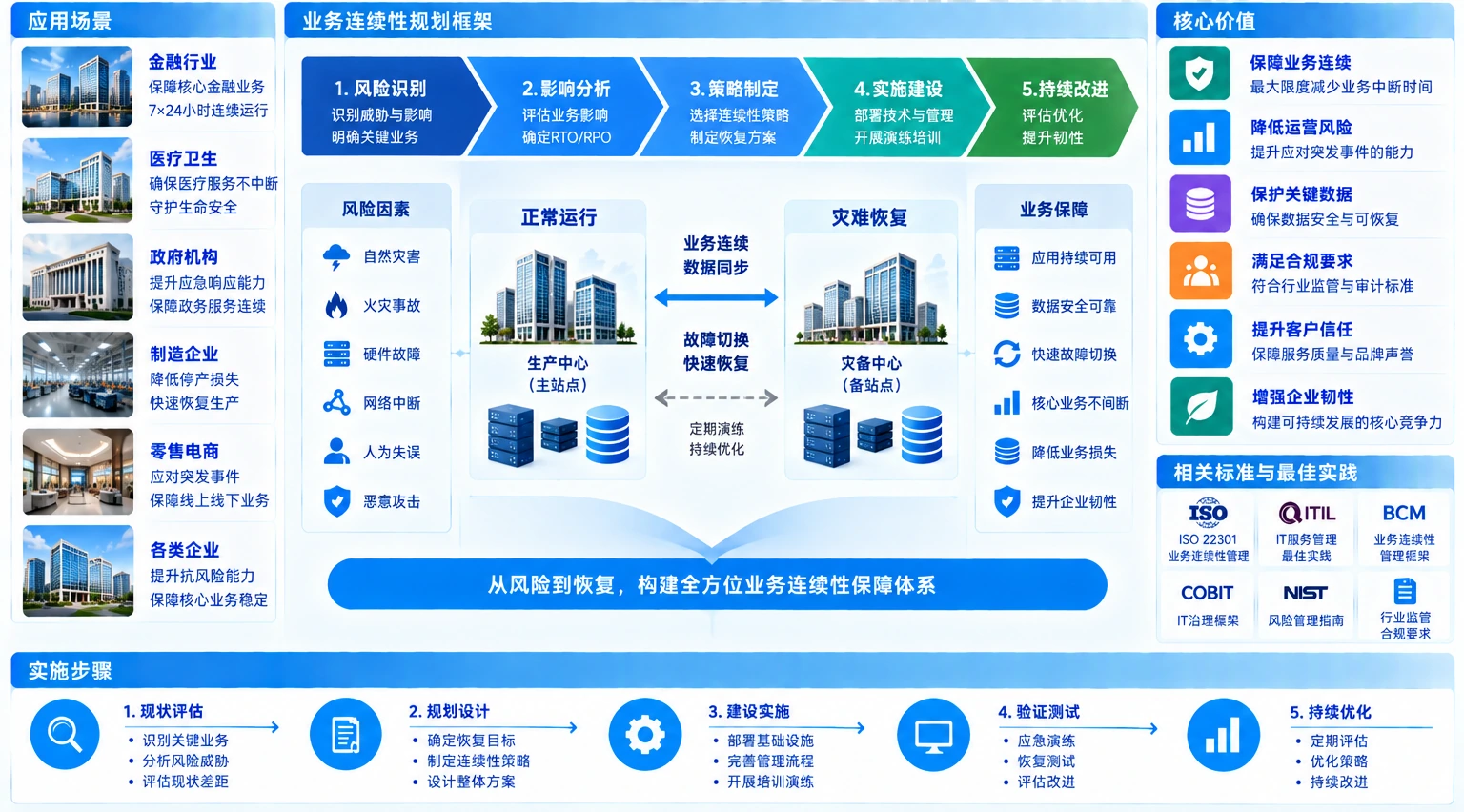
Choose availability, alternate circuits, remote resources, offline copies, manual workarounds or supplier coordination by dependency instead of adding hardware everywhere.
- Technical dependenciesSystems, data, identity, networking, interfaces and monitoring.
- Site dependenciesPeople, facilities, power, communications, equipment and working conditions.
- External dependenciesCloud, carriers, suppliers, logistics and customer interfaces.
03 / Disruption response
Maintain and restore in parallel
During disruption, determine impact and scope before activating communications, alternate operations, technical recovery and business approval. Without trigger conditions, teams wait between continued repair and continuity activation.
The response path names who declares the incident, coordinates resources, communicates externally, restores systems and approves business resumption.
- Incident classificationChoose response level by scope, estimated duration and business impact.
- Alternate operationsActivate alternate sites, manual processes, remote work or degraded service.
- Recovery and failbackRecover by priority and return to normal under business approval.
04 / Exercises and improvement
Exercise, remediate, retest
Business, technology, facilities and suppliers validate activation, contacts, alternate procedures, recovery timing and decision rights in representative scenarios. Findings move into remediation, retesting and version updates.
A continuity plan is effective only when contacts respond, resources are available, steps execute and results can be approved.
Exercise record