
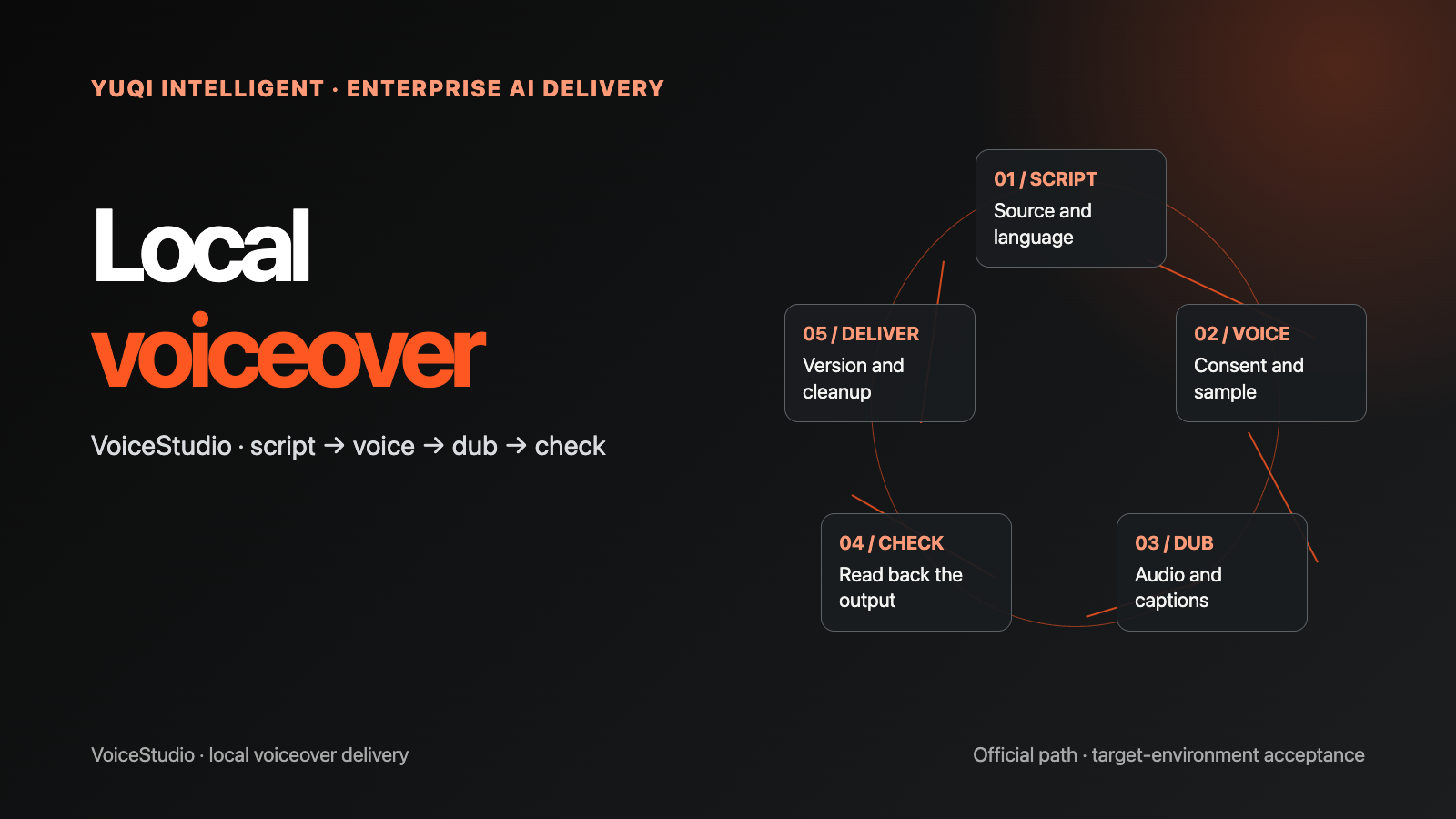
When a company wants voiceover for training, product explainers, or multilingual video, the difficult part is rarely finding a tool that can speak. The difficult part is recording the script source, voice consent, target language, human review, and final file requirements. VoiceStudio local AI voiceover materials cover voice cloning, video dubbing, dictation, long-form audio, and batch workflows, but an installation is not a delivery result.
A safer first step is one 30–60 second sample built from public or authorized material. Read back names, numbers, pauses, captions, timing, and file paths before discussing batch production or workflow integration. This guide separates official project facts from a delivery hypothesis. VoiceStudio was not installed on this machine, and no real audio was generated.
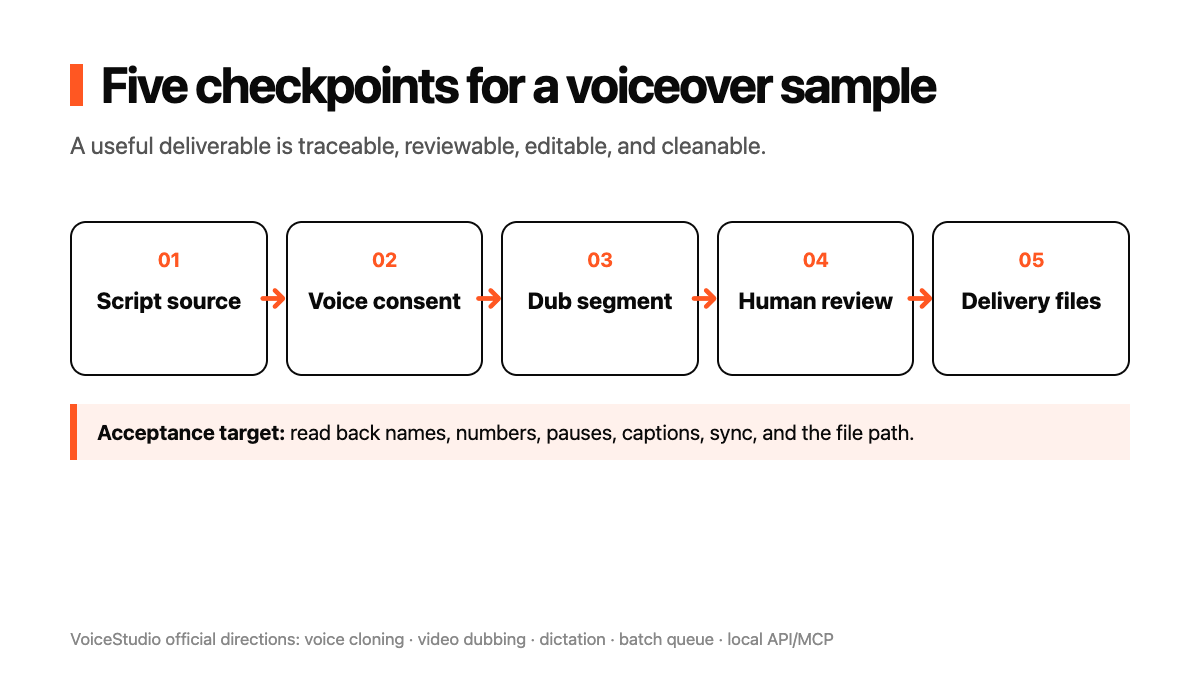
01 Translate “voiceover tool” into an accepted deliverable
“We want AI voiceover” is not yet a complete enterprise requirement. Record whether the material is training, product education, or an internal explanation; whether one or multiple languages are needed; whether the voice belongs to the operator, an employee, or a third party; and whether the output is audio, a captioned video, or an editable project file.
The opportunity hypothesis for VoiceStudio is not that it makes those decisions for the company. It is that part of the production path can run on local hardware. A first accepted item can include an authorized short script, a usable voice sample, source and target language segments, a caption/translation table, and a versioned human-review record.
That is a service hypothesis, not an official VoiceStudio promise and not evidence of a customer or order. If the buyer receives only an installer, they still have to handle pronunciation, translation changes, file naming, rollback, and data cleanup.
02 What the official materials document
The VoiceStudio repository describes workflows for voice cloning, video dubbing, dictation, and long-form audio. Its README lists:
- Voice Cloning and Voice Design using a short reference clip or a text description;
- Video Dubbing that transcribes, translates, preserves speakers, synthesizes, and exports video;
- Stories and audiobooks with multi-voice scripts, chapter rendering, and
.m4bexport; - Dictation Widget, Vocal Isolation, and Batch Queue for dictation, speech/background separation, and queued jobs;
- Local REST/SSE/WebSocket API, an OpenAI-compatible audio API, and an MCP Server.
The README also lists 16 TTS engines, 11 ASR engines, and a 646-language catalogue. A catalogue is not a promise of equal coverage or quality for every language; the project says actual coverage and quality depend on the selected engine. The project is marked Active beta, so a company should treat it as a toolchain that requires target-environment acceptance rather than a stable delivery guarantee.
03 Follow the official path and define success
The following is an official-source path, not a local test result. Download a package from the latest VoiceStudio release and follow the platform guide. The official macOS guide lists macOS 13.3 or newer, Apple Silicon, and about 10 GB of free disk space. The first launch prepares a Python environment and downloads models. Intel Macs may open the interface, but the official guide says the local Python backend is unsupported; use a remote backend or a supported platform instead.
For a source installation, the official macOS guide shows:
git clone https://github.com/debpalash/VoiceStudio.git
cd VoiceStudio
bun install
bun run desktop-prod
The guide also provides a one-line installation path. The first launch may create an environment with uv, synchronize dependencies, and download about 2.4 GB of model weights. Success is not just a visible window. At minimum, verify that Voice Cloning opens, an owned or consented sample can be selected, a specified language segment can be generated, the output file can be located, and logs and cleanup paths are understood. The README says three seconds can work and 5–15 seconds usually produces a better prompt; that is not an audio-quality guarantee.
Add the practical gates to the acceptance record: macOS Gatekeeper may require a one-time right-click Open confirmation; a Hugging Face token is not required for the default install but gated diarization and larger voice-design engines have extra conditions; downloads, remote backends, and network-backed features must not be inferred away from the phrase “local-first.”
04 Turn the first sample into a sellable delivery
A small team usually does not need to purchase a complete “AI voice system” on day one. It can judge one concrete segment: a product explanation in two languages, an internal training clip using a consented voice, or a short exhibition introduction for multilingual testing.
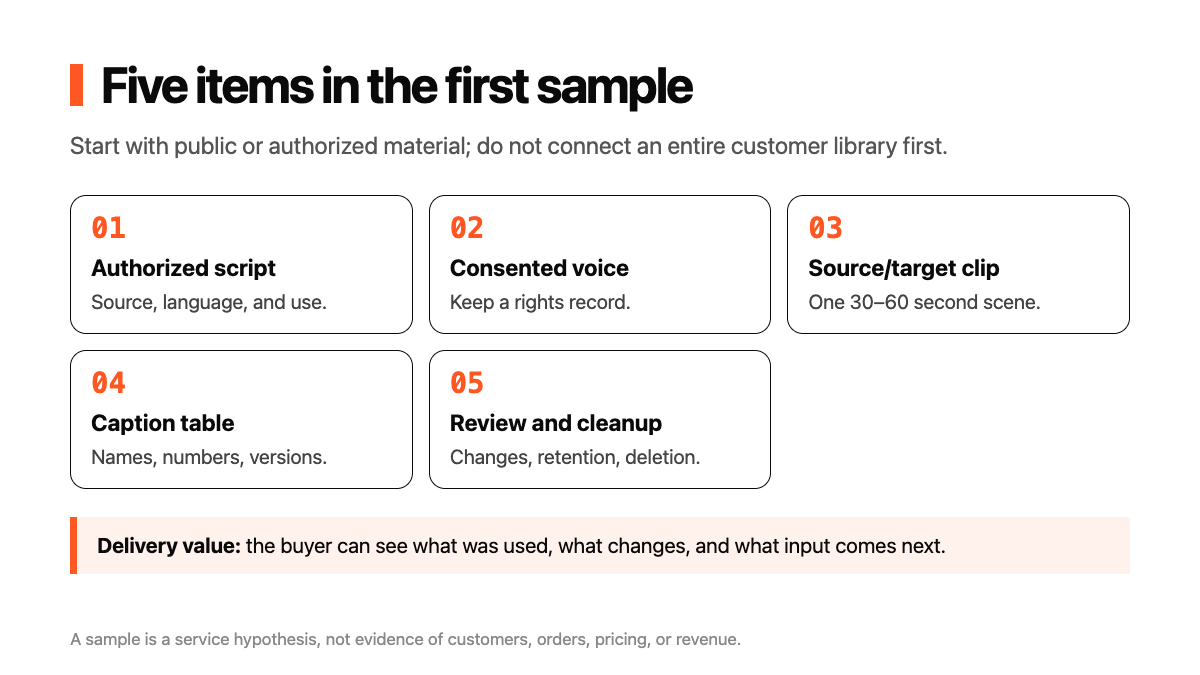
Fix the first sample as five items:
- Authorized short script: record source, purpose, language, and editing permission;
- Owned or consented voice: keep a separate rights record; “publicly audible” is not the same as consent;
- Source/target segment: use one 30–60 second scene instead of promising an entire long video;
- Caption/translation table: check names, numbers, units, pauses, and speaker order;
- Version and human-review record: record the engine, changes, retention, and deletion path.
The commercial path can begin with sample production, caption/translation cleanup, version management, and later workflow integration. Potential buyers include small teams with training audio, product explainers, or multilingual content needs. The first payment hypothesis is for a clear production and acceptance result, not for selling an installer or promising a savings percentage. This run has no customer interview, quote, order, or revenue evidence.
05 Separate the application license, voice rights, and data path
The VoiceStudio application is licensed under AGPL-3.0. Its README also says that downloaded models, tokenizers, and optional engines retain their upstream terms. The application license, model license, voice rights, script copyright, and customer-material authorization are separate checks.
Record at least the following:
- use only an owned or explicitly consented voice; do not make a public sample from a public figure, a customer employee, or an unknown speaker;
- use public, owned, or authorized scripts and video; do not upload customer source material first and explain the rights later;
- record paths and owners for models, engines, caches, logs, outputs, and remote backends;
- have a human review pronunciation, translation, pauses, speaker separation, and audio/video sync;
- if a modified version is distributed or offered as a network service, assess the corresponding AGPL duties separately from model and tokenizer terms.
Uninstalling is not the same as completing a compliance review. The official uninstall guide provides a dry-run-first path and warns that a shared Hugging Face cache may serve multiple projects. Before deletion, decide what must be retained, who approves removal, and whether another workflow depends on the cache.
06 Use seven days to test the next step
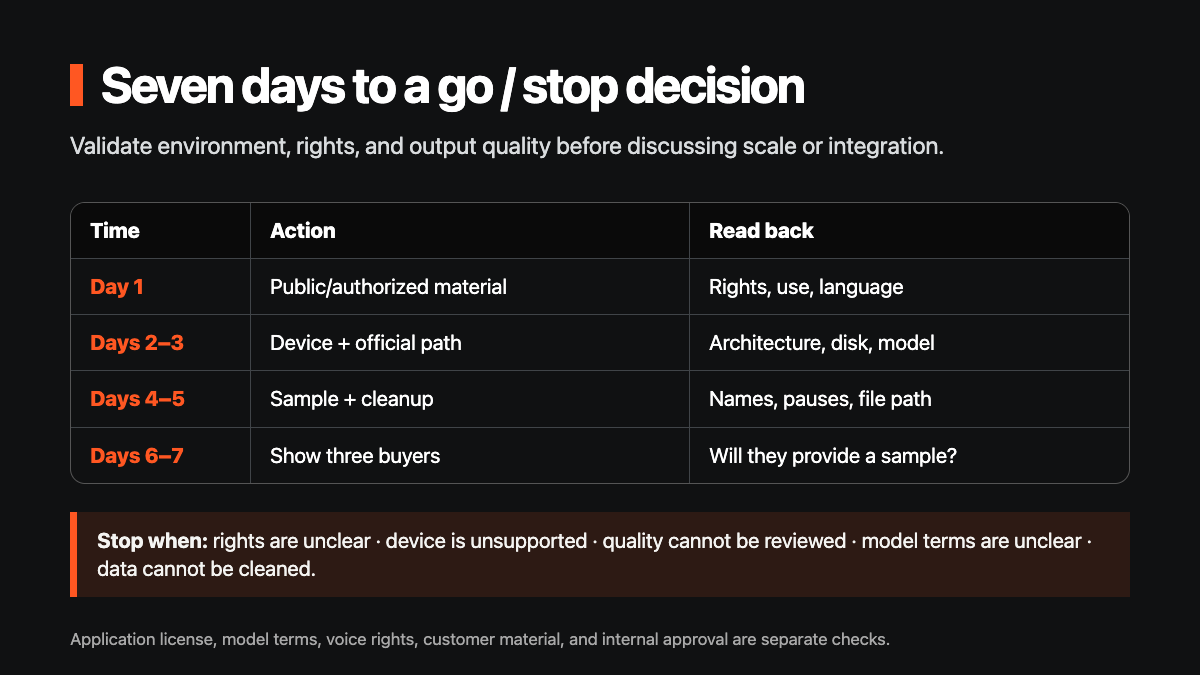
Seven days is a risk-limiting cadence, not a production-launch promise:
- Day 1: choose public or authorized script and voice material; record purpose and deletion rules;
- Day 2: check Apple Silicon/Windows/Linux, OS, disk, GPU/CPU, and model conditions;
- Day 3: prepare an isolated environment through the official release or source guide and record failures;
- Day 4: make one 30–60 second sample and review names, numbers, pauses, captions, and sync;
- Day 5: repeat one change and locate whether the issue came from input, engine, translation, or file path;
- Day 6: show the sample to three potential buyers and ask only whether a real training, product, or multilingual need exists;
- Day 7: discuss integration and maintenance only if someone will provide public or redacted material; otherwise stop at the owned sample.
07 Four checks for the project owner
- Are voice and script rights recorded, including purpose, language, and edit scope?
- Are the target device, application license, model/engine terms, and cache paths understood?
- Can names, numbers, translation, pauses, sync, and version rollback be reviewed by a person?
- Who retains, deletes, and approves customer material, logs, outputs, and shared model caches?
My view is that VoiceStudio is worth a low-risk sample test, but “local” is not a reason to skip consent or acceptance. If a company repeatedly produces training audio, product explainers, or multilingual video, it can describe its material source, languages, and delivery format through the website and then assess whether a localized workflow automation project is appropriate. Scope remains subject to enterprise approval, official documentation, and target-device testing.
Company information
Shanghai Yuqi Intelligent Technology Co., Ltd. | Website: https://www.yuqi-sh.com/ | Scope: enterprise IT infrastructure, networking and information security, servers and storage, virtualization, systems integration and intelligent low-voltage engineering, IT operations, software, and AI workflow automation. | Service area: Shanghai and nearby businesses.