
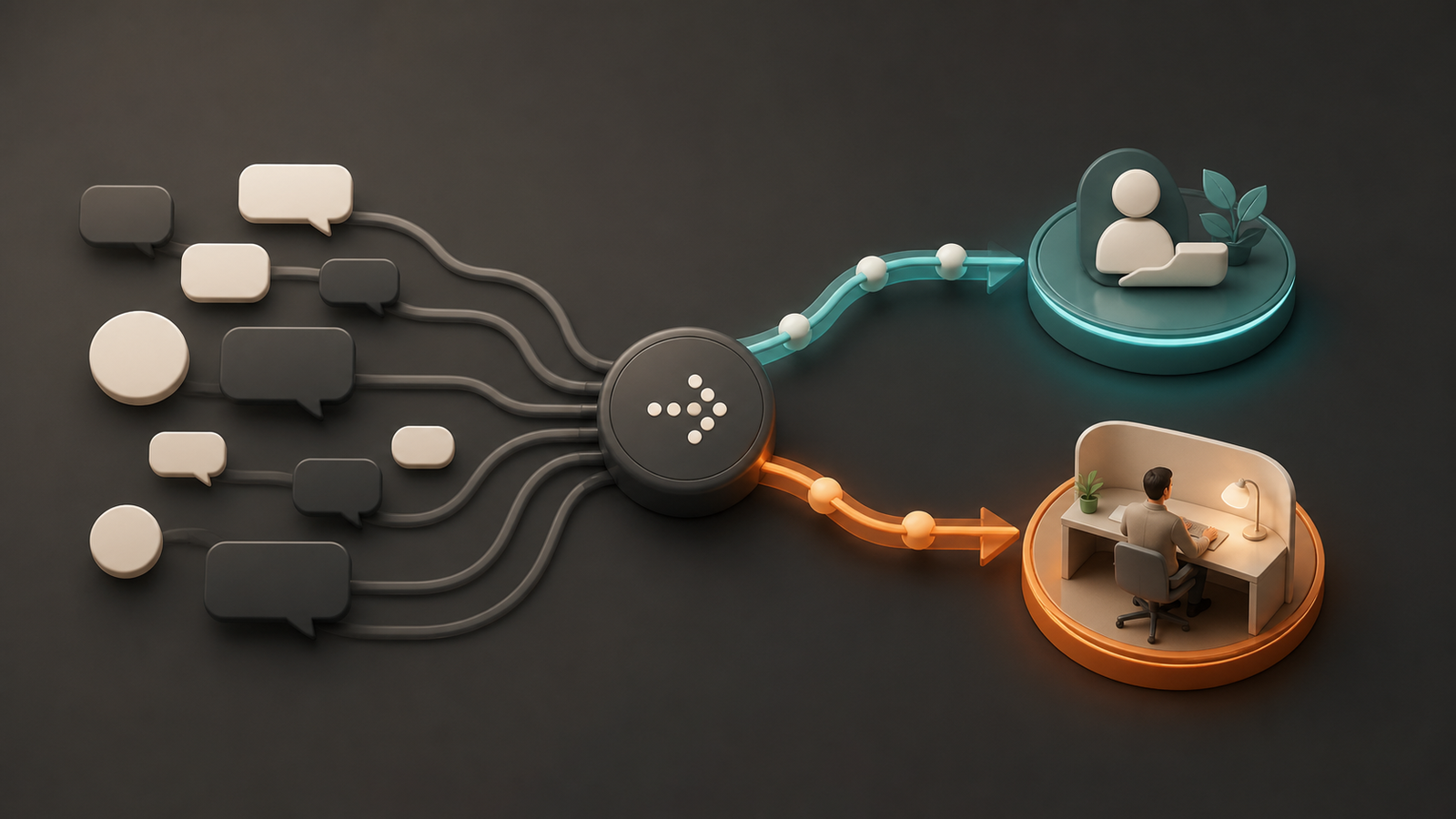
Why AI Customer Service Still Needs Clear Human-Handoff Rules
Businesses adopt AI customer service to answer common questions around the clock and reduce repetitive work. The most damaging failure is often not a bot that cannot speak. It is a bot that speaks fluently enough that the organization assumes every conversation can remain automated.
When a customer is making a complaint, disputing a payment, requesting a refund, or asking for a formal commitment, repeated template-style responses do not improve efficiency. They merely place automation between the customer and the person who can take responsibility. The operational question is therefore not only what the AI can answer, but when it must stop and hand the case to a person.
The ability to answer is not authority to decide
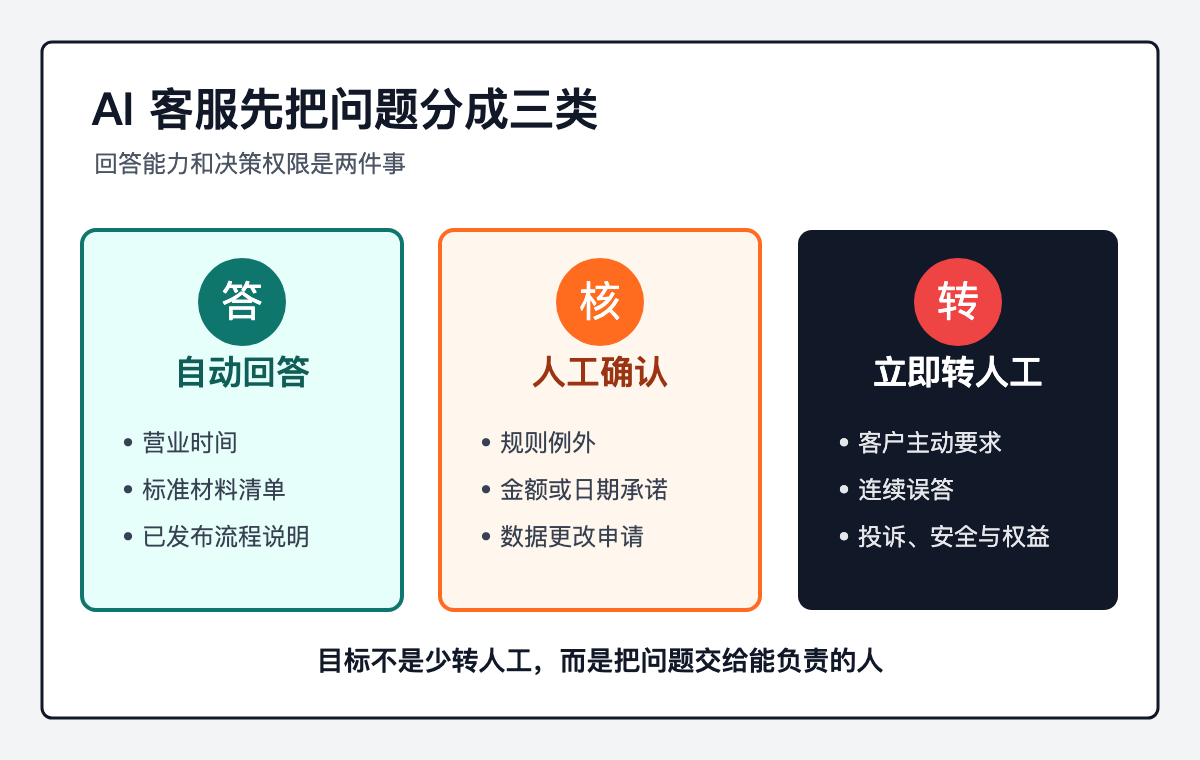
AI customer service is useful when it retrieves approved knowledge and explains stable procedures in natural language. Opening hours, standard document lists, and published process instructions are usually suitable candidates. Once facts are incomplete or a case involves exceptions, emotion, money, data changes, or a company commitment, the task changes from “finding an answer” to “making an accountable decision.”
A plausible response does not mean that a business has authorized the system to issue a refund, amend an order, accept liability, or promise a delivery date. If permissions, business rules, and accountable owners have not been defined, fluent language may cause customers to treat an unapproved answer as a formal commitment.
Every AI service design therefore needs two sets of instructions: how to answer and when to stop answering, who receives the case, and what information follows it.
Human handoff is part of the design, not a failure
Microsoft's Copilot Studio documentation treats live-agent handoff as a product capability. Customers may request a person, and the system may escalate after unrecognized intent or at a defined topic. Conversation history and selected variables can be passed to the agent. Google Cloud's Dialogflow documentation likewise describes marking a specific intent as a live-agent handoff event.
Those documents do not prove that either platform fits a particular company. They do demonstrate a sound design principle: mature customer-service automation does not optimize for “never transfer.” Automation should close clear, low-risk, stable cases. People should handle exceptions, judgment, authorization, and relationship repair.
A bot saying “I will transfer you” is not a completed handoff when there is no receiving queue, no owner, and no useful context. Nor is it reasonable to require a customer to type “human agent” repeatedly before the flow changes.
Define the handoff conditions before launch
Every business will need its own list, but several conditions deserve early attention.
First, the customer explicitly asks for a person. The service may state hours and queue status, but more automated persuasion should not be used to block the request. Second, the system repeatedly fails to understand the question or produces irrelevant answers. Continuing to guess makes the customer repeat work.
Third, the conversation involves identity, payment, refunds, contract terms, pricing exceptions, data changes, or a formal commitment. These actions often require permissions, an audit trail, or approval. Fourth, the case involves an escalating complaint, safety risk, privacy concern, or a dispute that may affect customer rights. The receiving person may need to involve a supervisor, legal team, security team, or another accountable owner.
Not every high-risk case needs an immediate live chat. A business can create an “answer after human review” path. What matters is that the customer sees the current status, somebody owns the case, and the outcome is recorded.
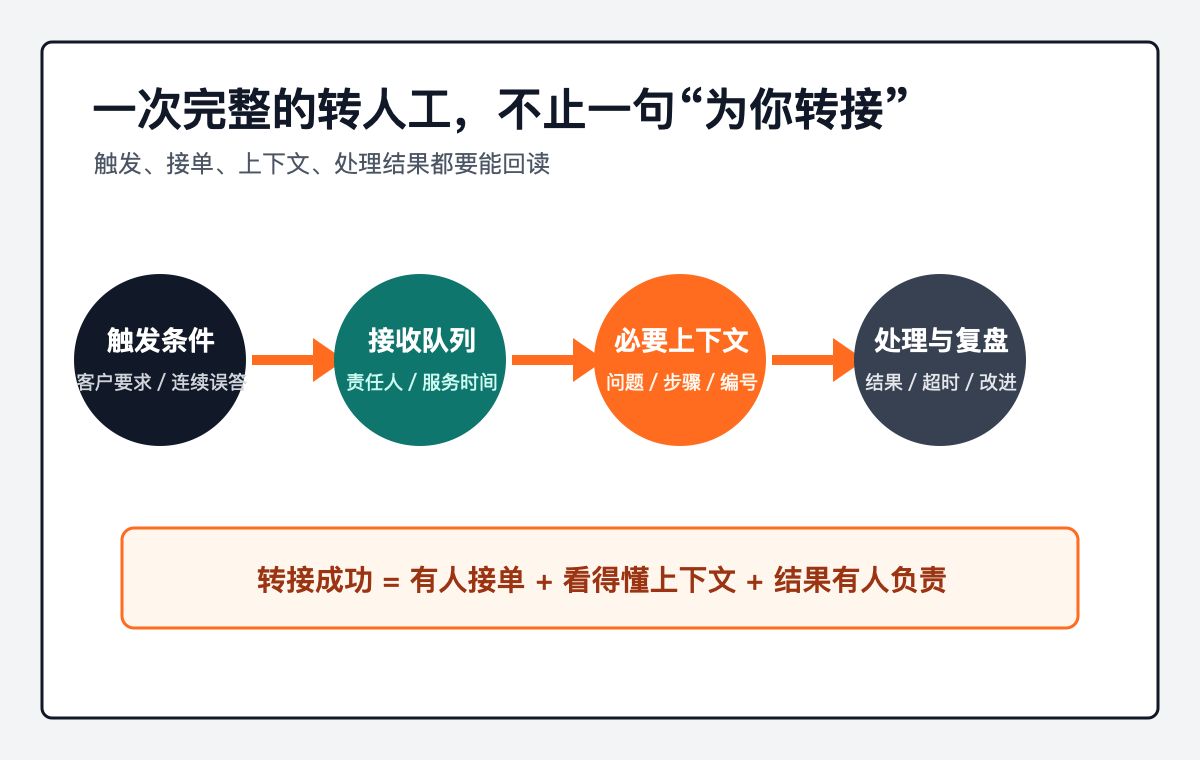
Acceptance criteria should also define evidence of a successful transfer: the case reached the intended queue, the person received the minimum context, the customer saw an accurate waiting status, and an overdue case followed an escalation rule. A transfer message without an assignment record is not a completed process.
Transfer only the context the person needs
Passing context with the handoff reduces the need for a customer to start again. Microsoft's documentation lists examples such as conversation history, the previous topic, the customer's expression, and custom variables. That does not mean storing every raw field indefinitely or showing all data to every agent.
Define the minimum necessary context: the current issue, verified identity state, troubleshooting already attempted, the relevant order or ticket number, and the reason automation could not finish. Access to sensitive fields, retention, and display rules should follow the organization's own privacy and permissions policies.
The NIST AI Risk Management Framework and its playbook provide voluntary references for human oversight, role accountability, and documented escalation. A smaller business does not need a heavy governance program to begin, but it still needs to say who receives the case, who approves high-impact actions, and who reviews failures.
Five actions to complete before launch
- Divide cases into three classes. Document what automation may complete, what needs human confirmation, and what must go directly to a person.
- Write explicit trigger conditions. A human request, repeated misunderstanding, a complaint, or a high-impact action should end the automated loop and open a defined escalation path.
- Assign the receiving queue and owner. Sales, support, finance, or a supervisor needs service hours, a timeout rule, and a fallback when nobody is immediately available.
- Pass only necessary context. Give the person the issue, actions already attempted, and required identifiers while controlling sensitive data, access, and retention.
- Record and review failed conversations. Track which questions often escalate, where customers abandon the flow, and whether agents received enough context. Then decide whether to improve knowledge, redesign the process, or reduce automation scope.
The value of AI customer service is not that it hides the human entrance. It is that simple cases end sooner and complex cases reach an accountable person earlier. Acceptance testing should therefore cover complaints, exceptions, explicit human requests, and unavailable-agent conditions—not just a list of questions the bot can answer.
If your organization is designing an AI customer-service channel, service desk, or support-ticket workflow, contact Yuqi Intelligence to map the boundary between automated answers and accountable human escalation, beginning with your current channels and recurring cases.
Sources
- Microsoft Learn, Hand off to a live agent: <https://learn.microsoft.com/en-us/microsoft-copilot-studio/advanced-hand-off>
- Google Cloud, Dialogflow ES handoff: <https://docs.cloud.google.com/gemini-enterprise-cx/agent-assist/handoff-es>
- NIST AI RMF Core: <https://airc.nist.gov/airmf-resources/airmf/5-sec-core/>
- NIST AI RMF Playbook: <https://airc.nist.gov/airmf-resources/playbook/>