
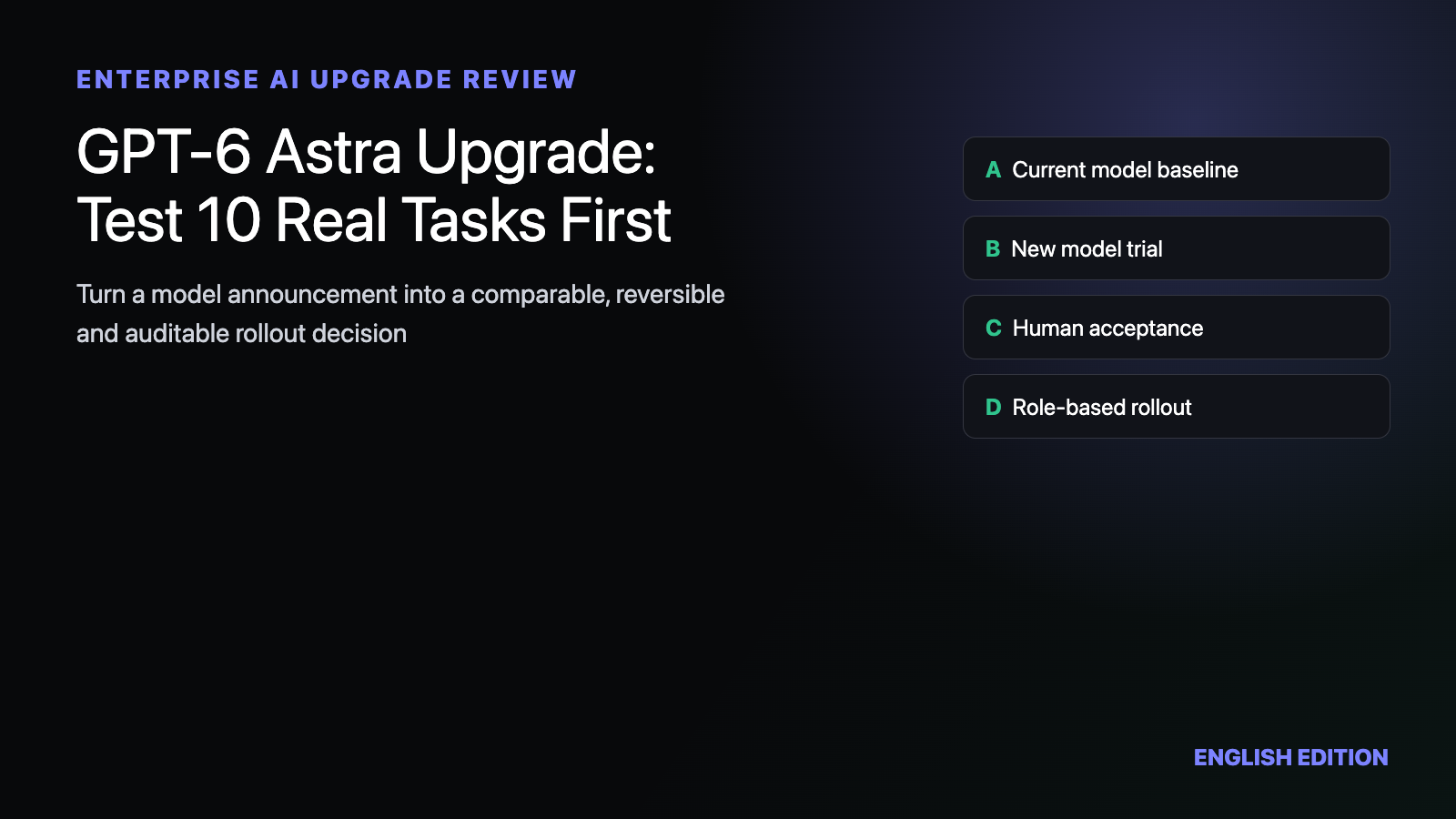
When a new model arrives, an organization can easily enable it broadly and decide to measure the outcome later. That order makes the result hard to interpret. Without a current-model baseline, representative samples, authorization boundaries and stop conditions, the team cannot distinguish genuine improvement from longer outputs, more retries or additional review work.
This GPT-6 Astra enterprise upgrade checklist is for owners, managers and IT leads at small and midsize organizations in Shanghai and nearby areas. It describes a limited and reversible evaluation. It does not claim that every organization should upgrade, and it does not treat vendor benchmarks as evidence of a business outcome.
Confirm availability, administrator control and price
OpenAI's GPT-6 Astra launch page says that access is rolling out in phases across ChatGPT plans and API channels. Enterprise access is off by default at launch and must be enabled by an administrator. The API model name is gpt-6-astra; standard API pricing is listed as USD 10 per million input tokens and USD 50 per million output tokens.
These facts describe the service, not your rollout decision. Before any trial, confirm whether the workspace has access, who is allowed to participate, what data may be supplied and which actions still require human approval. Payments, deletion, external messages and account changes should not inherit authority simply because the model is more capable.
OpenAI's GPT-6 Astra safety overview classifies the model at the Critical level for cybersecurity capability and describes additional safeguards. For an enterprise, stronger computer-use and tool-use capability increases the importance of least privilege, approval and reliable post-action readback.
Start with three reversible tasks
Do not begin by changing the default model for the entire workforce. Choose three frequent tasks that are easy to review and safe to reverse, such as drafting a customer-service response, assembling an operations report, or producing a read-only IT check summary. Preserve the result from the current model as the baseline for each task.
Change only the model during a comparison. Keep the source material, instructions, output format, tool permissions and reviewer constant. Otherwise, an apparent improvement may come from a different prompt, document version or reviewer rather than the model.
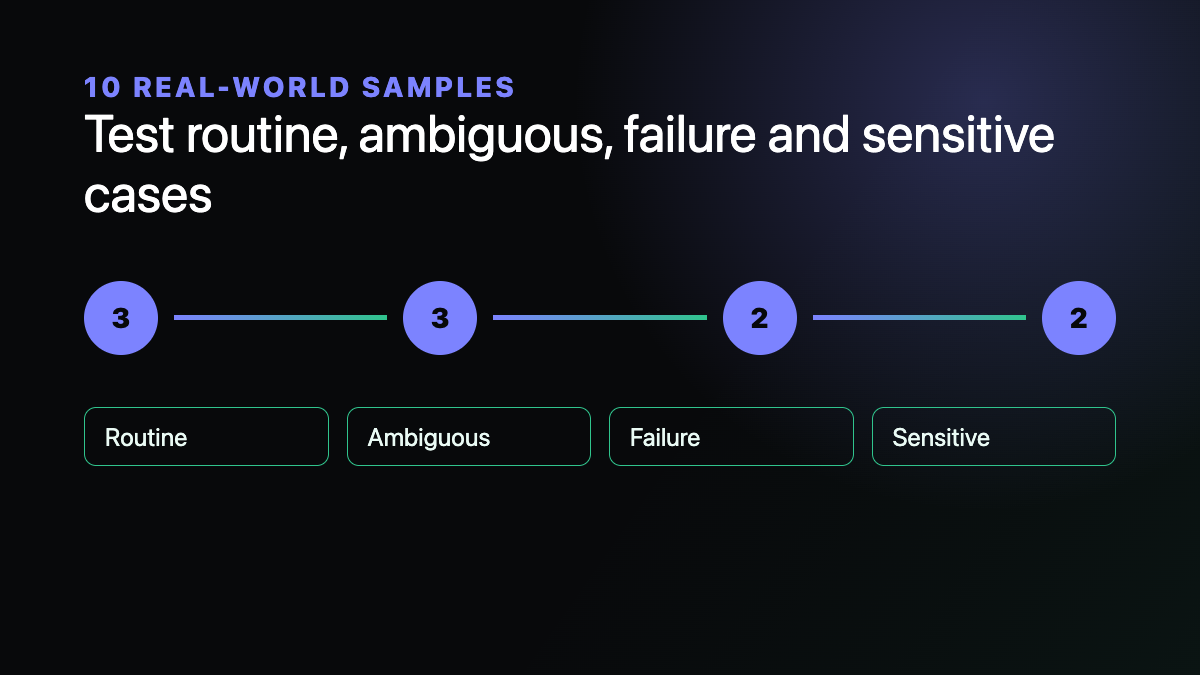
Build a ten-sample set for each trial task:
- Three routine samples to assess factual accuracy, format and completeness.
- Three ambiguous samples to see whether the model invents missing details or asks for clarification.
- Two failure samples with missing input, damaged formatting or unavailable tools.
- Two sensitive samples that test whether customer data or high-impact actions trigger human approval.
Remove information that is not needed for the test. A polished demonstration covers the happy path; it does not replace failure and authorization testing.
Measure quality, rework, time and authorization
Quality requires field-by-field review of facts, numbers, formatting, references and required elements. A fluent answer is not automatically a correct answer. Contracts, quotations, customer commitments and system actions still need the accountable owner to confirm them.
Rework should record how many edits a reviewer makes, where they occur and why. A longer answer that requires more deletion is not an efficiency improvement. Repeated errors in one field may indicate that the input structure or workflow needs correction before access expands.
Time and cost include model runtime, retries, human verification and coordination. Published API prices are only a starting point. Long context, long output, caching choices and repeated attempts all change the actual cost. Use your own usage and labor records rather than extrapolating savings from another organization's case.
Authorization is a release gate. A tool should receive only the authority needed for the specified task. A visible button, a proposed action or a workflow that has reached its final step is not authorization to pay, delete, send or change account settings. If the result cannot be read back, record the state as unknown or blocked.
Define stop and rollback conditions first
Set the stopping rules before the trial begins. Pause when factual error exceeds the accepted business threshold, output formatting remains unstable, human rework does not decline, cost exceeds the agreed limit, or a task reaches data or actions outside its authorization.
A phased rollout also means that some accounts may not see the model immediately. An unavailable model, uncertain administrator setting or unknown submission state should not trigger repeated refreshes or clicks. Confirm the platform state before continuing.
After the samples are reviewed, choose one of four outcomes: expand the trial, restrict use to selected roles, keep the current model, or stop and redesign the workflow. Attach the samples, measures and accountable reviewer to that decision.
A handoff checklist for the project owner
- List the three trial tasks, permitted actions, prohibited actions and reviewers.
- Preserve the sanitized samples, current-model baseline, new-model outputs and edits.
- Record quality issues, rework, elapsed time, usage, cost and authorization exceptions.
- Define the conditions for expansion, role-limited use, retaining the current model and rollback.
- Keep the decision, unresolved issues and the next review date after the trial.
To turn an enterprise AI model trial into a traceable and reversible operating process, use Yuqi's project enquiry form to describe the current tasks, tools, data scope and approval requirements. The service scope depends on the environment and the work agreed by both parties.
Prepared by Shanghai Yuqi Intelligent Technology Co., Ltd. with AI-assisted research and source review. The diagrams are original deterministic technical graphics and contain no customer data, measured performance or vendor endorsement. Sources reviewed on September 7, 2026.