
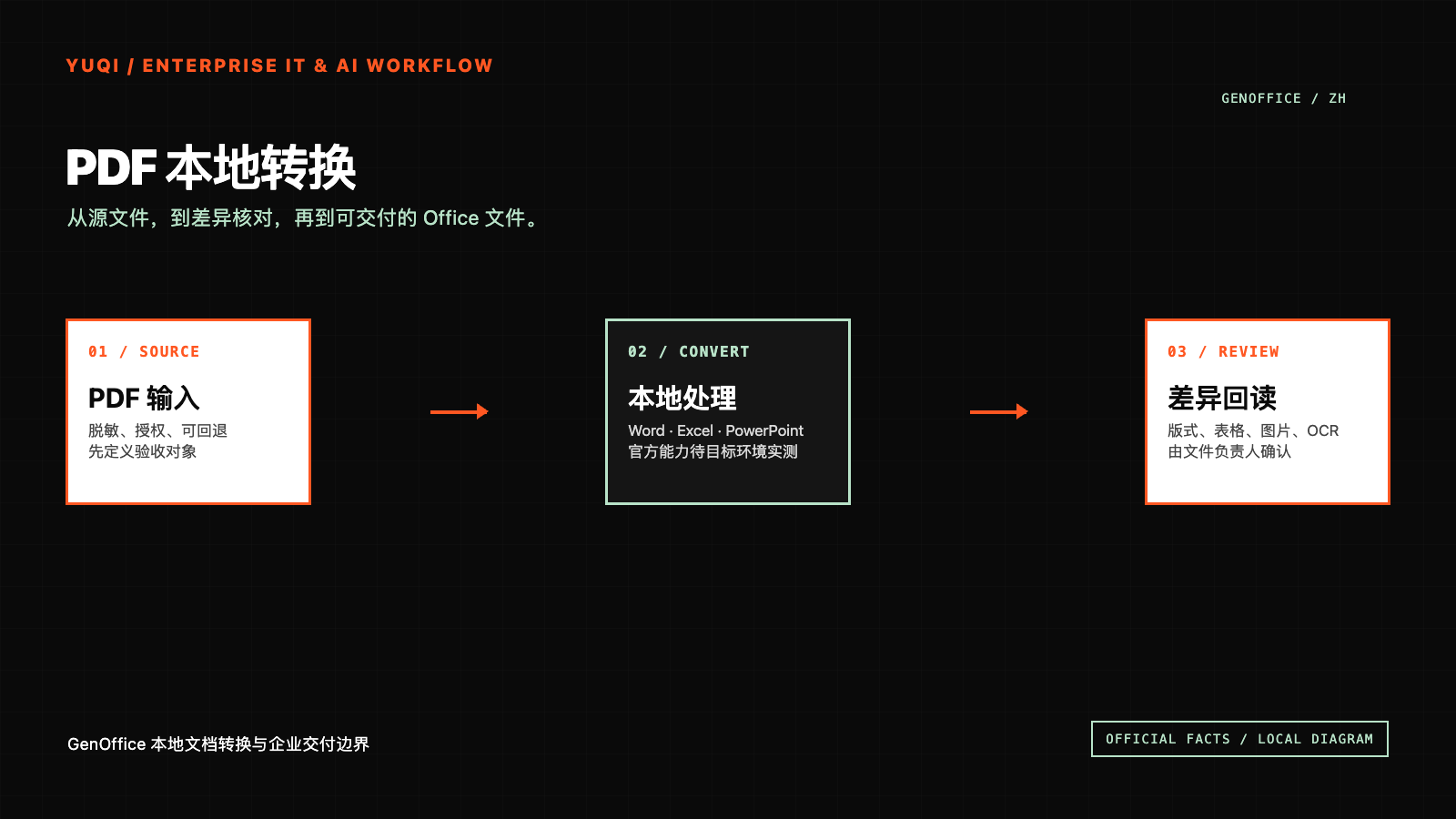
When enterprise files move repeatedly between PDF, Word, Excel, and PowerPoint, the hard part is not simply opening a file. The team also needs to know whether layout survives, whether the material may reach a network service, who reviews conversion differences, and how to return to the original. GenOffice local document conversion materials cover Office formats, PDF, Markdown, and AI editing, but an installation is not a replacement decision.
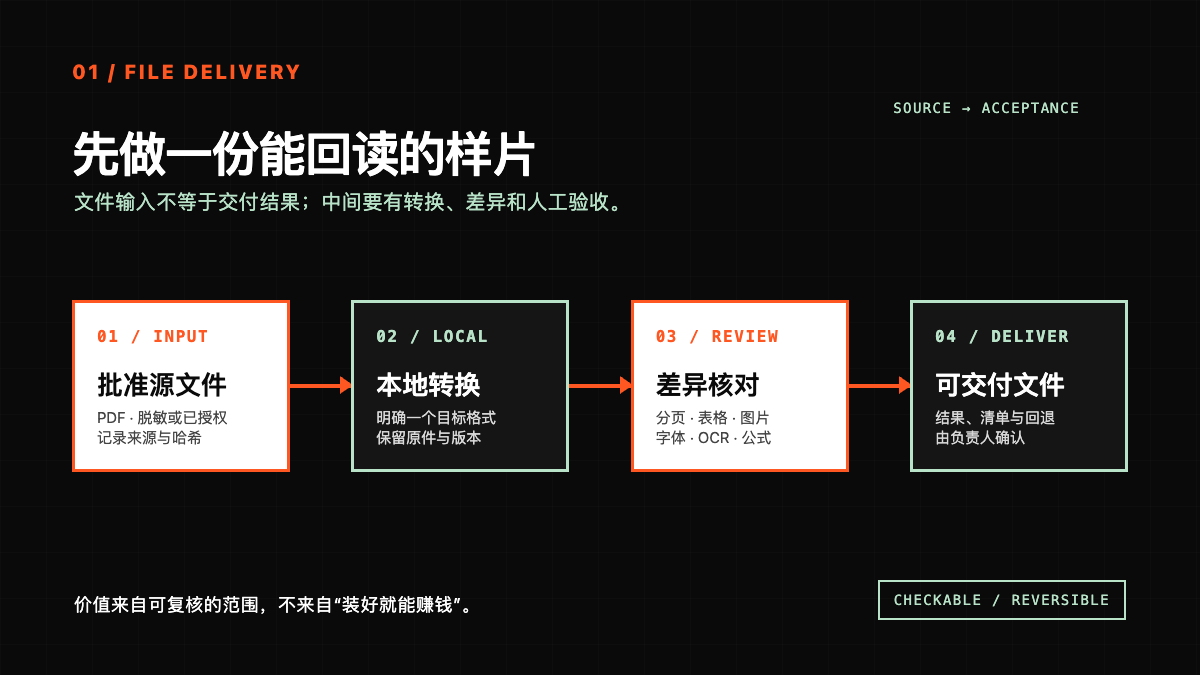
A safer first step is a small sample using a redacted or approved PDF. Keep the original, convert to one explicit target format, and have the file owner review pagination, tables, images, formulas, fonts, and OCR errors. GenOffice was not installed or tested on this machine; this page separates official project facts, privacy notes, and the enterprise delivery hypothesis.
01 Translate “office software” into a file deliverable
“Find an Office tool with AI” is too broad. Record whether the input is a text PDF, a scanned PDF, a contract attachment, a quotation sheet, or training material. Record whether the output is Word, Excel, PowerPoint, or still PDF. Most importantly, record whether the acceptance target is text, pagination, tables, formulas, fonts, or the final visual appearance.
The testable opportunity around GenOffice is not a blanket promise to replace Office. It is a bounded file task with a readable result. A first item can include the source file, converted result, difference list, data-path table, and rollback note. That is a service hypothesis, not an official project promise and not evidence of customers, orders, or revenue.
02 What the official materials list
The official README describes GenOffice as an open-source Office alternative for macOS, Windows, and Linux. It opens and saves .docx, .xlsx, and .pptx, and edits PDF and Markdown. It also lists:
- local PDF conversion to editable Word, PowerPoint, and Excel;
- system OCR for scanned PDFs on macOS and Windows;
- Docs, Sheets, Slides, PDF, and Markdown editors;
- block-level AI editing, version snapshots, and diffs;
- BYOK and custom OpenAI-compatible model endpoints.
These are directions described by the official project. Compatibility, layout fidelity, OCR results, and AI output still need acceptance on the target device and on real but authorized files.
03 Check the system before the AI request
The official latest release is v0.8.970, with packages for macOS arm64/x64, Windows, and Linux. The README lists macOS 11+, Windows 10+, and platform-specific requirements for deb, rpm, or AppImage on Linux. Its source-development path includes npm install, npm run fixtures, npm test, and npm run dev; that is a developer path, not a minimum deployment promise for ordinary office users.
The first record should include the OS, package source, file type, before/after differences, failure information, and rollback method. Do not call a window opening a successful deployment, and do not promise compatibility with every Office file without testing.
04 How to accept the first enterprise sample
Fix five items: an approved source PDF, one explicit target format, a difference list, a data-path table, and a version/rollback note. The difference list should cover pagination, fonts, tables, images, formulas, and OCR errors. The data-path table should separate ordinary document editing, AI features, external model endpoints, and usage analytics.
This sample can grow into document cleanup, format conversion, template repair, or workflow integration. The value comes from a clear, reviewable, reversible scope, not from a product name or an “efficiency gain” poster. This run contains no customer interview, quote, order, or revenue evidence.
05 Local document editing does not mean every request is offline
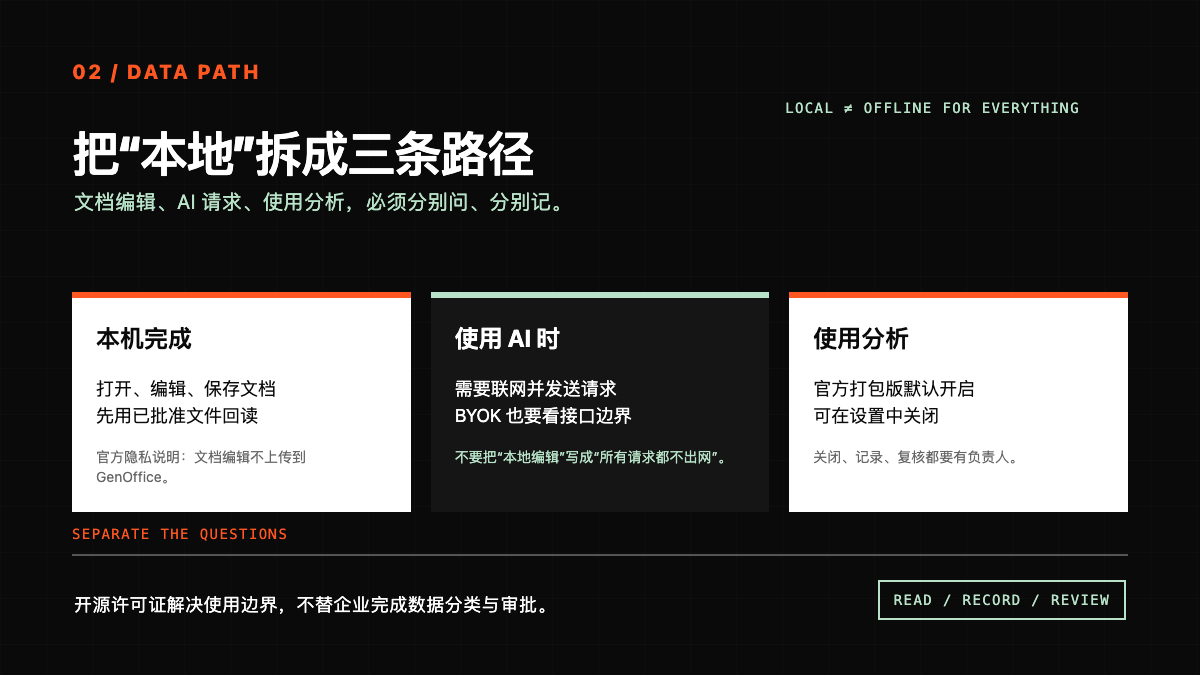
GenOffice’s official privacy note separates three paths: opening, editing, and saving documents happen on the local machine; AI features require a network connection and send requests when used; official packaged builds enable limited usage analytics by default, with an opt-out under Settings → General → Send anonymous usage statistics. An enterprise must confirm which files may be processed locally, which AI requests may leave the device, whether analytics is enabled, and who records the review.
The application repository uses Apache-2.0, but upstream components, model services, API keys, and the company’s data policy still require separate assessment. An open-source license does not replace data classification, approval, key management, or customer authorization.
06 A seven-day bounded validation
On day 1, choose a redacted or approved PDF and record its hash; on day 2, confirm the system, hardware, package, and network requirements; on day 3, prepare through the official release path and record failures; on day 4, try one PDF-to-Word, spreadsheet, and presentation scenario; on day 5, review pagination, tables, images, formulas, fonts, and OCR; on day 6, check AI requests, analytics, and BYOK/local endpoints; on day 7, let the file owner decide whether to proceed to templates, batch work, or integration.
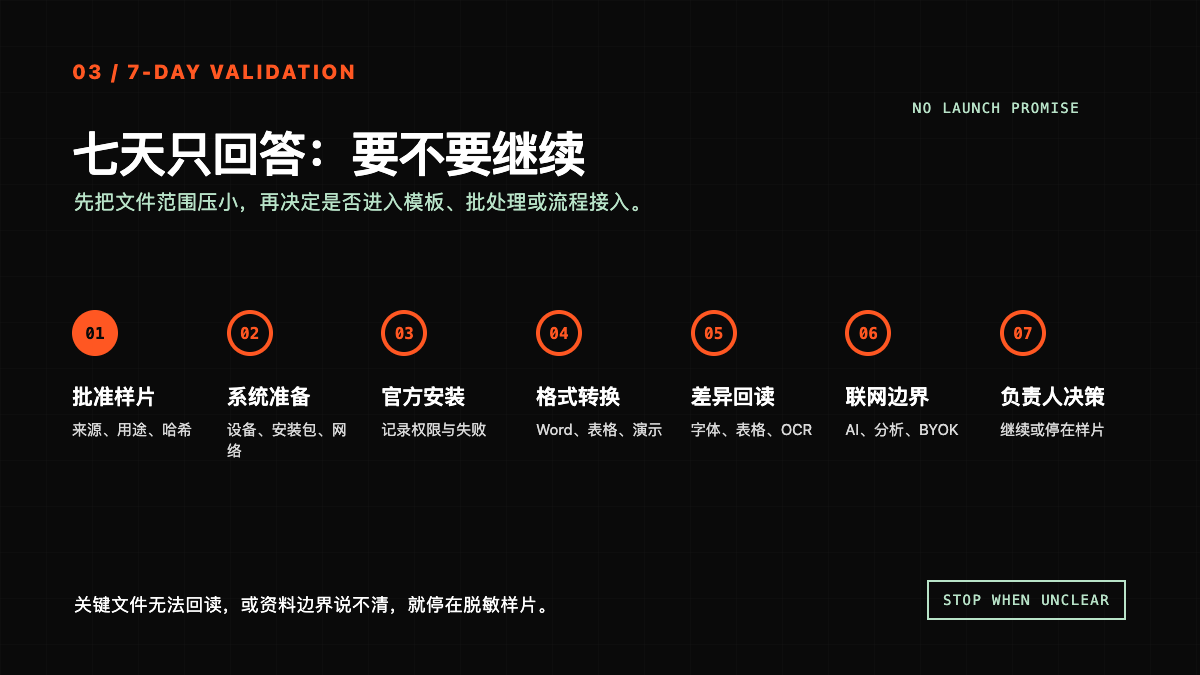
If a key file cannot be reviewed or the data boundary is unclear, stop at the redacted sample. Do not turn “installed” into a production result.
07 Four questions for the owner
- Must the acceptance preserve text, pagination, tables, formulas, or final visual appearance?
- Which files may be processed locally, and which AI or external-model requests may not use the network?
- Are the target device, package, application license, upstream components, and model/API terms understood?
- Who reviews differences, retains originals, manages rollback, disables analytics, and gives final approval?
GenOffice is worth a low-risk sample using an approved PDF, but “open source,” “local,” or “AI” is not enough to promise compatibility, confidentiality, or savings. If document-format rework is a recurring drag on the business, describe the file types, system environment, and delivery requirement first, then decide whether local workflow automation is appropriate.